Longing to Know Fully As I Am Fully Known
Language, intimacy, and the God who calls us His children


“Now we see through a glass darkly, but then face to face.
Now I know in part; then shall I know fully, even as I have been fully known.”
— 1 Corinthians 13:12
Larry David once joked that English speakers are missing an entire social category because we only have one word for “you.”
He said he could immediately tell whether an audience understood the joke. Anyone who grew up speaking a language with formal and informal forms of address knew exactly what he meant. In those languages, every conversation quietly carries a decision.
Are we close enough for tú yet?
Have we earned the tú?
Did I step into familiarity too soon?
People laugh because they recognize the tension. A single pronoun can hold respect, hierarchy, affection, caution, warmth, distance, and belonging. Spanish has tú and usted. German has Du and Sie. Farsi has toh and shoma. One form draws near. The other preserves reverence, caution, or social space.
In Farsi, this contrast can feel especially striking. A child may call his own father or grandfather shomā out of respect. Shomā carries honor, deference, and reverence.
Yet in the Persian Lord’s Prayer, God is addressed with toh, the intimate form. The prayer says, Ey Pedar-e mā ke dar āsmānī, nām-e toh moqaddas bād — “Our Father who is in heaven, hallowed be Your name.”
The phrase nām-e toh means “Your name,” but it uses the intimate form, not the formal one. The Father in heaven is infinitely holy, yet Jesus gives us the language of nearness.
The same pattern appears in German. A respected stranger or authority might be addressed as Sie, but the Lord’s Prayer begins, Vater unser im Himmel, geheiligt werde dein Name — “Our Father in heaven, hallowed be Thy name.” The word dein comes from du, the intimate form. Spanish does something similar: Padre nuestro que estás en los cielos, santificado sea tu nombre. Again, tu nombre uses tú, not usted. Across these languages, the prayer Jesus gives us does something astonishing. It joins reverence to intimacy.
English has mostly lost that distinction. Everyone is simply “you.” But in much of the world, grammar still carries relationship.
That small linguistic difference opens a window into something profound about prayer. Most cultures instinctively reserve elevated forms of speech for authority. Sovereigns, judges, elders, teachers, and strangers are approached with deference. Power often creates distance.
Children speak differently to their father.
And this is what Jesus gives us.
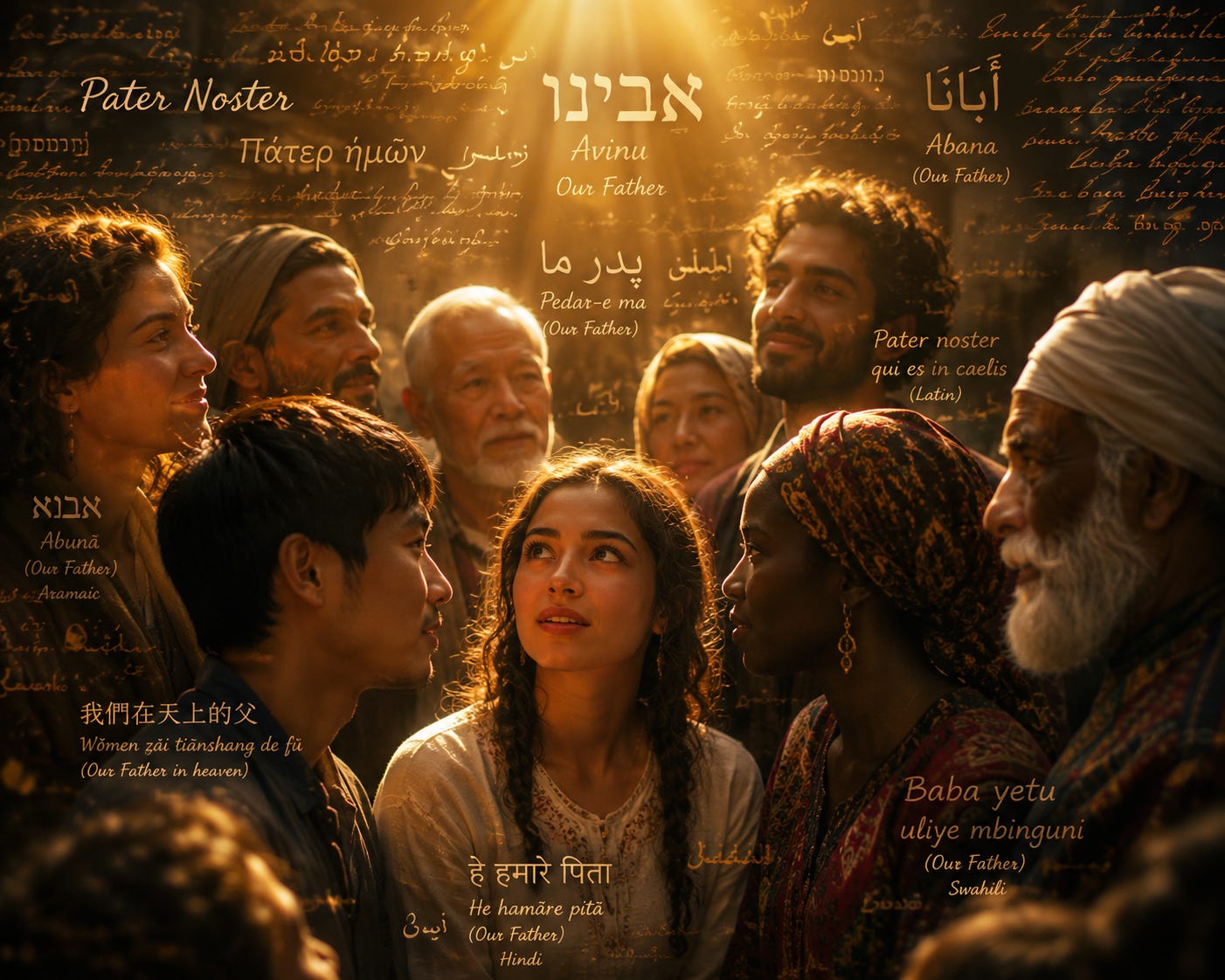
When He teaches His disciples to pray, He does not begin with guarded distance, bureaucratic formality, or trembling abstraction. He teaches them to say:
“Our Father in heaven, hallowed be Your name.”
— Matthew 6:9
The holiness remains. The reverence remains. The name is still hallowed. Yet the first word of the prayer places us inside relationship.
Older English partially hides the intimacy of this from modern readers. Words like thou and thy now sound ceremonial because they are archaic, but historically they belonged to the familiar form of address. They were closer to tú than usted, closer to Du than Sie. What now sounds elevated was once intimate.
Paul says this same thing in the language of adoption:
“For you did not receive the spirit of bondage again to fear, but you received the Spirit of adoption by whom we cry out, ‘Abba, Father.’”
— Romans 8:15
And again:
“And because you are sons, God has sent forth the Spirit of His Son into your hearts, crying out, ‘Abba, Father!’ Therefore you are no longer a slave but a son, and if a son, then an heir of God through Christ.”
— Galatians 4:6–7
After the Resurrection, Jesus says to Mary Magdalene:
“Go to My brethren and say to them, ‘I am ascending to My Father and your Father, and to My God and your God.’”
— John 20:17
The Gospel does not lead us into greater distance from God, but into restored communion. What was fractured is brought near again.
Fearful servants are welcomed as sons and daughters. Those who hid in shame are called back into the light. In Christ, we are given the language, freedom, and nearness of beloved children standing before a holy Father.
Holiness That Draws Near
Scripture never minimizes the holiness of God.
Sinai trembles……
Isaiah falls before the throne and hears the seraphim cry:
“Holy, holy, holy is the Lord of hosts; the whole earth is full of His glory!”
— Isaiah 6:3
Daniel loses his strength and falls facedown. Ezekiel falls upon his face. Peter, overwhelmed by the revelation of Christ, cries out:
“Depart from me, for I am a sinful man, O Lord.”
— Luke 5:8
John, seeing the risen Christ, writes:
“When I saw Him, I fell at His feet as though dead.”
— Revelation 1:17
This holiness is not sentimental. It is weighty, overwhelming, and beyond human self-possession.
Yet what happens next is just as remarkable.
The holy God does not merely overwhelm them; He moves toward the very place where fear has left them exposed. For Isaiah, the fire that might have seemed terrifying becomes the means of mercy, as God provides the touch that cleanses the lips Isaiah himself had confessed as unclean. For Daniel, whose strength had left him, God sends a hand to steady and raise him.
Peter hears Christ answer his fear with vocation:
“Do not be afraid. From now on you will catch men.”
— Luke 5:10
And when John falls at the feet of the risen Christ as though dead, the Lord does not leave him there. He places His right hand upon him and says…..
“Fear not.”
— Revelation 1:17
The God whose presence causes mountains to tremble also moves toward human beings with tenderness.
Psalm 139 carries this mystery with extraordinary intimacy:
“O Lord, You have searched me and known me.”
— Psalm 139:1“Before a word is on my tongue, behold, O Lord, You know it altogether.”
— Psalm 139:4“You formed my inward parts; You knitted me together in my mother’s womb.”
— Psalm 139:13
David pours out joy, rage, shame, longing, gratitude, fear, repentance, and worship because he lives before the God who already sees him fully and still draws near.
This may be why David is called a man after God’s own heart. He continually returns into relationship.
The holy God of Sinai invites human beings into the speech of beloved children.
From I–It to I–Thou
Martin Buber described two ways of relating to reality: I–It and I–Thou.
In an I–It relationship, another being becomes something to categorize, analyze, manage, or use. Modern life trains us in this constantly.
An I–Thou relationship moves differently. The other person is encountered as presence rather than utility. They carry mystery, depth, and personhood beyond category.
Buber believed every genuine I–Thou encounter ultimately points toward what he called the Eternal Thou.
Scripture says something even more astonishing. The Eternal Thou already knows us completely.
When Jesus says,
“I never knew you.”
— Matthew 7:23
to those who answer,
“Lord, Lord, did we not prophesy in Your name?”
— Matthew 7:22
He brings everything back to relationship. The issue is not religious performance. The issue is communion.
Love is personal. It moves toward recognition, listens carefully, calls people by name, and refuses to turn human beings into abstractions.
We live in a world that steadily turns persons into categories. The neighbor becomes a demographic, the sufferer a diagnosis, the worker a measure of productivity, and the human face slowly recedes behind the language of politics, commerce, medicine, and media.
Even necessary categories can begin to replace encounter when efficiency becomes stronger than reverence.
The Holy of Holies in the Human Person
Abraham Joshua Heschel warned that modern people risk becoming technically sophisticated while gradually losing the capacity for awe. He described encountering another human being almost as entering the Holy of Holies itself, because every person bears the image of God.
That image has stayed with me.
I have often thought about it in medicine and surgery. Modern operating rooms contain astonishing sophistication: sterile gowns, gloves, masks, drapes, robotic instruments, imaging systems, molecular data, monitors, protocols, and precision tools capable of entering the hidden interior of the human body with extraordinary accuracy. Even the preparation resembles liturgy. Hands are scrubbed carefully. Sterile garments are donned in sequence.
Instruments are arranged attentively. A boundary is crossed into vulnerable human space where precision matters because life itself matters.
Yet medicine also reveals how easily reverence can erode under pressure. The patient becomes “the prostate biopsy,” “the pancreatic mass,” “the BRCA case,” or “the trauma in room four.” Clinical language has its place, but modern systems constantly tempt us to preserve the tools while losing the awe.
“So God created man in His own image.”
— Genesis 1:27
The Hebrew idea of avodah carries a remarkable richness. It can mean work, worship, and service all at once. In Genesis, humanity is placed in the garden to tend and keep it. Later, avodah becomes priestly language connected to temple service.
Those ideas were never meant to be separated.
Love offered to image bearers becomes holy work.
Compassion carries a priestly quality, not because ordinary people become objects of worship, but because every person bears the image of God. When we meet one another with truthful presence, mercy, attentiveness, hospitality, and care, ordinary encounters begin to resemble the quiet service of a sanctuary.
This may be why the Lord’s Prayer begins with relationship before petition.
“Our Father…”
The God Who Calls by Name
Holiness and intimacy remain joined throughout Scripture. Even the name Elohim carries this tension. Grammatically plural, yet often joined to singular verbs, it suggests majesty, fullness, and transcendence beyond ordinary categories. Yet this same God walks in the garden, speaks with Abraham, wrestles Jacob, calls Samuel by name, and enters covenant with His people.
Again and again, God’s movement is personal.
“Adam, where are you?”
— Genesis 3:9“Moses, Moses.”
— Exodus 3:4“Samuel! Samuel!”
— 1 Samuel 3:10“Mary.”
— John 20:16“Simon, son of John, do you love Me?”
— John 21:17
This is the language of encounter.
This is also why Pentecost matters so deeply. When the Spirit descended and the Church was born, people from across the known world heard the Gospel in their own languages.
“We hear them telling in our own tongues the mighty works of God.”
— Acts 2:11
Parthians, Medes, Elamites, Egyptians, Romans, Arabs, and Jews from many nations heard the mighty works of God in the language closest to the heart.
The Kingdom did not begin by erasing human particularity. It entered directly into it. Babel scattered language through pride and self-exaltation. Pentecost gathered people through communion. God spoke to each one in a language they could understand, as though divine love naturally moves toward intimacy, recognition, and understanding.
Manna, Mammon, and Being Fully Known
In Jesus, the mercy of God takes on flesh.
“The Word became flesh and dwelt among us.”
— John 1:14
He becomes bread for the hungry and living water for the thirsty. He welcomes the stranger and makes enemies into guests. He carries human suffering into Himself and opens communion where shame once produced hiding.
To know Him, then, is not merely to understand religious information. It is to participate in His life.
Scripture even uses the language of husband and wife to describe this knowing, because covenantal intimacy creates safety for transparency. Every fear, contradiction, wound, longing, and hidden thought already stands fully before Him.
And still He invites us near.
“For now I know in part; then I shall know fully, even as I have been fully known.”
— 1 Corinthians 13:12
Mammon slowly erodes…..training the heart toward transaction, leverage, image, consumption, and performance.
Relationships become markets…..branding identity, managing spirituality.
People then become instruments for our security, influence, or self-protection.
Manna moves differently by arriving daily.
“Give us this day our daily bread.”
— Matthew 6:11
It teaches dependence, trust, communion, and presence.
Not hoarded or controlled but a means of deep heart formation.
Receiving rather than grasping… abiding and not performing…..rooted in love having been loved first.
“We love because He first loved us.”
— 1 John 4:19
This is part of the quiet vocation of every believer: to become a priest of presence in a fragmented world, carrying reverence into ordinary encounters, recognizing the image of God in one another, and practicing avodah through love.
I long for presence more than power, for communion more than performance, and for the kind of abiding where usefulness, correctness, impressiveness, and self-protection can finally give way to being fully known and still welcomed.
I want to know fully, even as I have been fully known.
References & Influences
The Holy Bible
Martin Buber, I and Thou
Abraham Joshua Heschel, God in Search of Man, The Insecurity of Freedom, Man Is Not Alone
Themes of avodah in Genesis, Temple worship, and priestly service
Pentecost narrative, Acts 2
Psalms of David, especially Psalm 139