Today we want to revisit a story we often tell too simply.
It is the story of Western civilization.
Many of us inherited some version of a straight line: Greece, then Rome, then Europe, then Britain, then America. Along the way, words like classical and Western begin to sound neutral, as though they are merely describing history. But those words often do more than describe. They arrange the world. They teach us where to look for the center and what to treat as background.
Greece and Rome become the “classical” inheritance. Persia is pushed eastward. Israel is treated as religious history rather than civilizational history. Egypt becomes ancient scenery. Mesopotamia becomes a primitive beginning before the real story starts. India and China are placed outside the frame altogether as “non-Western.”
But history was never that clean.
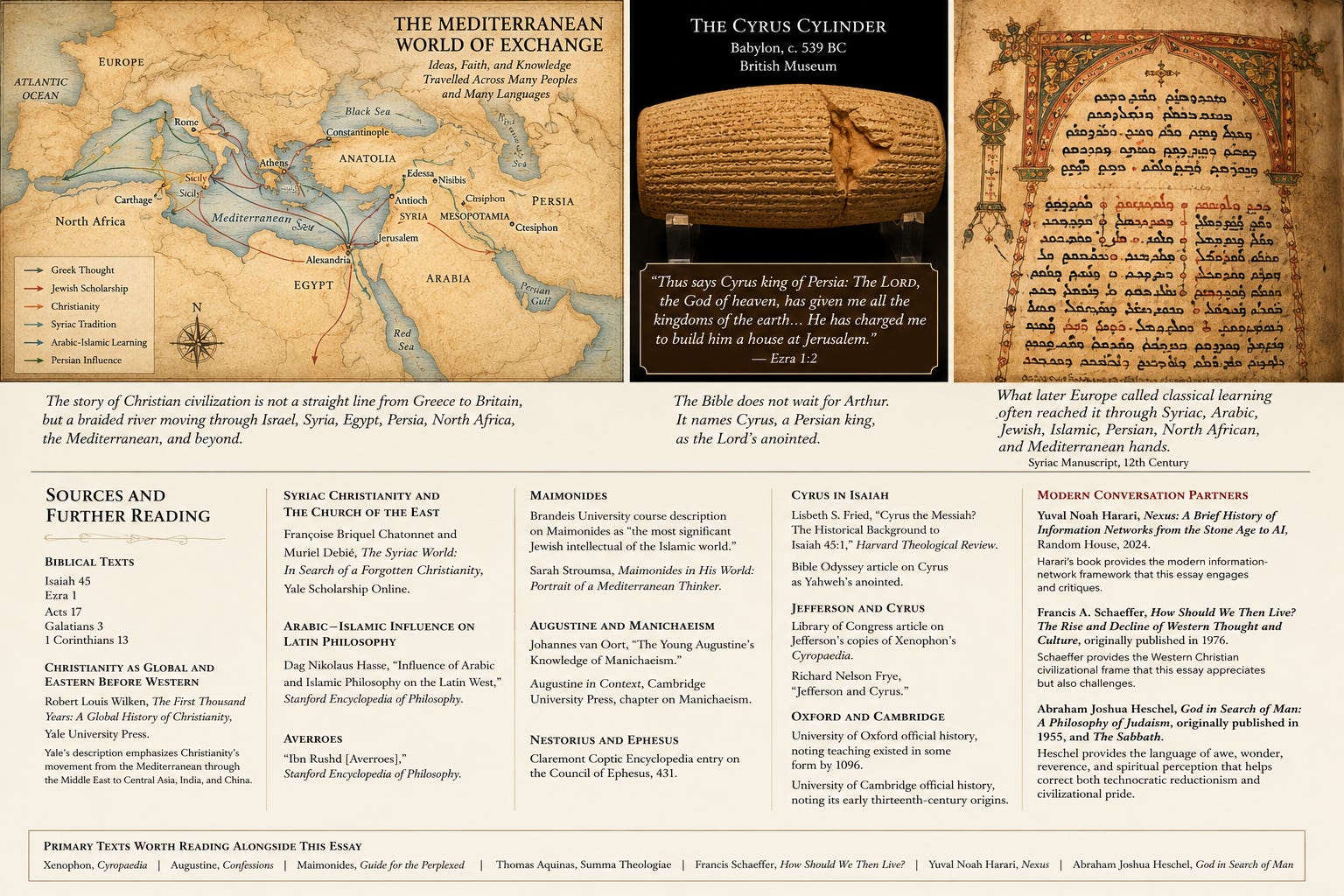
Civilization is not a single line of self-generated greatness. It is more like a river, fed by many streams, moving through many peoples, languages, empires, exiles, translators, scholars, merchants, monks, rabbis, physicians, and forgotten hands.
That matters because Christianity began far from the centers later associated with Western Christendom. Jesus lived as a Jew in the land of Israel under Roman occupation. Paul moved through the eastern Mediterranean world. The apostles carried the Gospel through Galilee, Judea, Samaria, Syria, Asia Minor, Greece, North Africa, and beyond.
The early Church took root in Jerusalem, Antioch, Alexandria, Edessa, Cappadocia, Ethiopia, Persia, and Rome long before it became identified with the later institutions, universities, reformations, and national cultures of Europe.
The Gospel is larger than any civilization that later received it. It entered the West, shaped the West, and blessed the West in profound ways. Its earliest world was Jewish, Near Eastern, Mediterranean, and imperial Roman. Its promise was always global.
Christianity emerged from Israel, Second Temple Judaism, the eastern Mediterranean, Syria, Egypt, North Africa, Anatolia, Mesopotamia, Greek language, Roman roads, Persian imperial memory, synagogue networks, exile, trade, and empire.
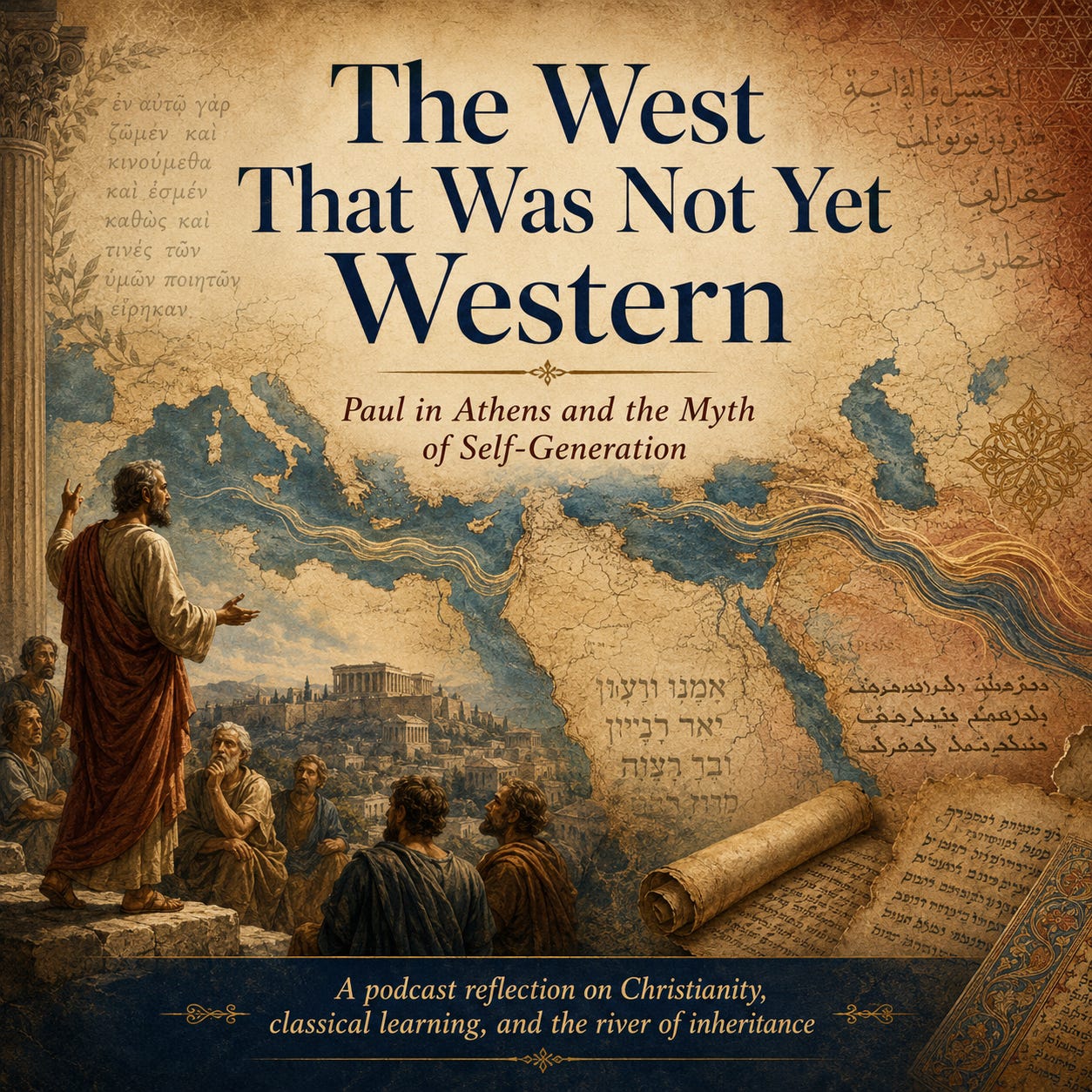
Paul gives us a better imagination for this. In Acts 17, when he stands in Athens, and begins with God.
He tells them that God made every nation, appointed their times and boundaries, and gives life and breath to all. Greek culture is engaged, but not worshiped. Paul is not anti-Greek. He is anti-boasting.
That distinction matters.
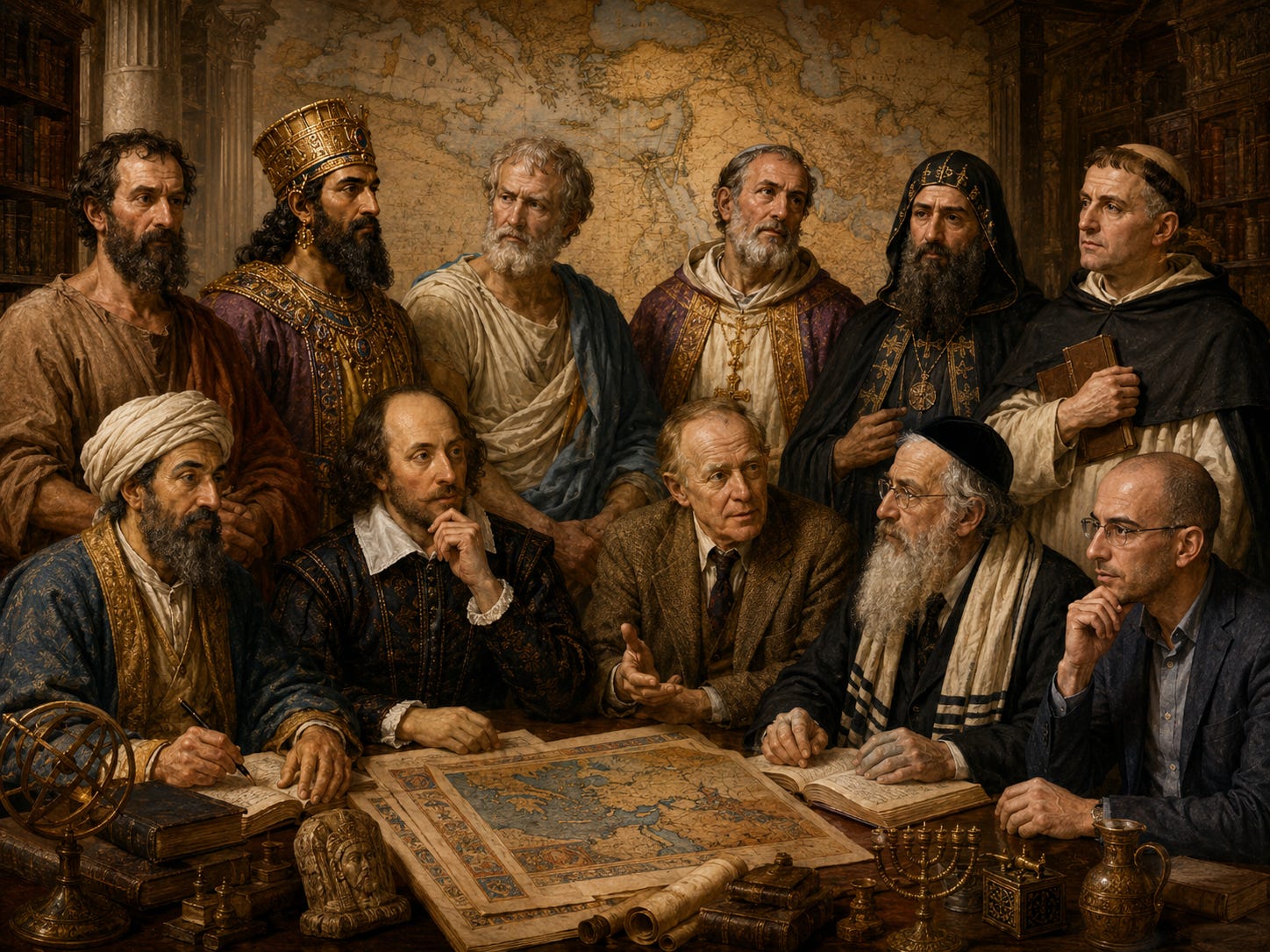
The West received Scripture, philosophy, law, literature, theology, medicine, and learning through a long chain of inheritance. Aristotle reached the Latin West through preservation, translation, commentary, and debate involving Syriac Christians, Arabic philosophers, Jewish scholars, Islamic thinkers, Persian physicians, North African theologians, and Mediterranean translation centers. Aquinas was brilliant, but his brilliance belonged within a river that had already been flowing for centuries.
The same is true of Augustine, a North African bishop later claimed too easily as a “Western father.” It is true of Maimonides, whose life in Córdoba, Morocco, and Egypt reminds us that Jewish, Arabic, Islamic, Aristotelian, legal, medical, and theological thought was flourishing in the Mediterranean world before England’s Magna Carta. It is true of Cyrus, the Persian king whom Isaiah names as the Lord’s anointed, long before Europe wrapped its imagination in Arthur, Camelot, and sacred kingship.
That is where the biblical contrast between manna and mammon helps me. Manna receives with gratitude. Mammon grasps and calls the gift its own. Manna remembers dependence. Mammon forgets where gifts came from.
This episode is about that forgetting.
It is about the myth of self-generation. It is about the way history education can teach us to see the West as the source rather than the receiver. It is about Harari, who sees networks but often loses the soul, and Schaeffer, who sees the danger of losing the soul but narrows the network too much. It is about Paul in Athens, who shows us how to engage a civilization without bowing to its pride.
The Gospel belongs to Christ.
Wisdom is not tribal property.
And the faithful response to a received inheritance is not civilizational boasting.
It is gratitude.