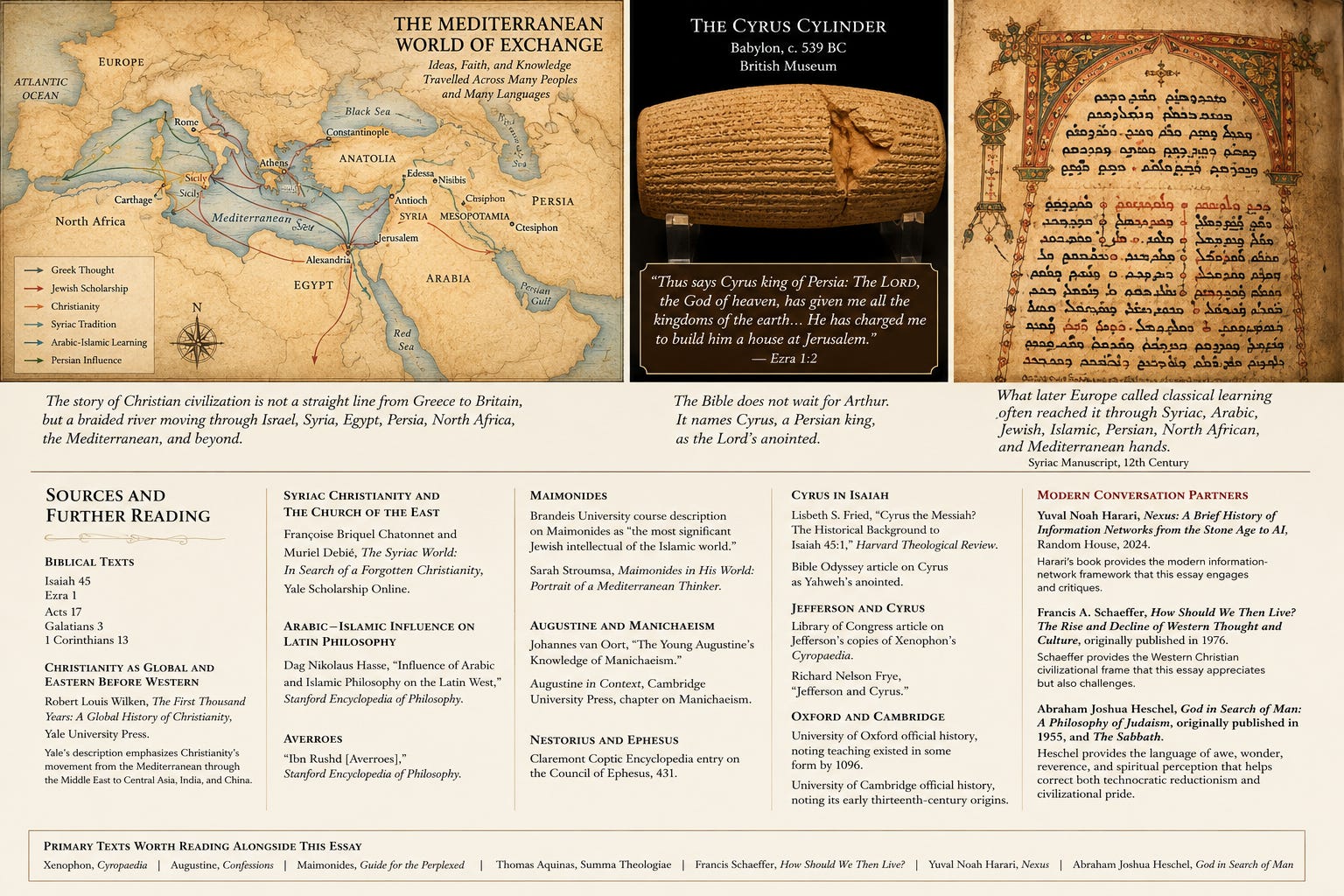
The West That Was Not Yet Western
How Christianity, Classical Learning, and Civilization Were Received Before They Were Claimed

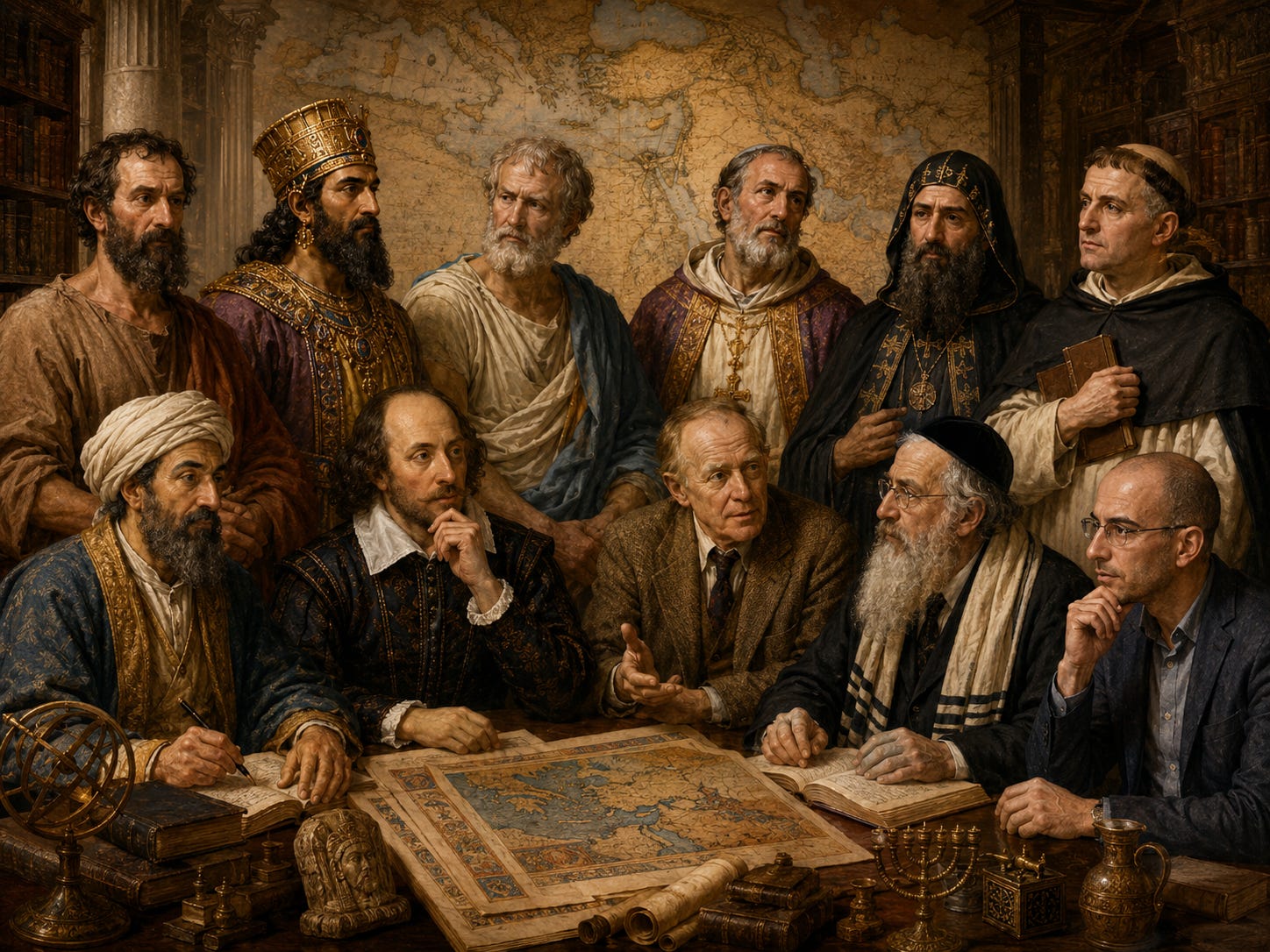
Modern civilizations often tell stories about themselves that slowly become myths of self-generation.
They inherit gifts from others, absorb knowledge carried across deserts and seas, receive traditions translated through multiple languages and peoples, and eventually begin speaking as though they created these things themselves.
That temptation is ancient………The Bible calls it forgetting.
My own way of seeing this is through the difference between received life and grasped possession. Scripture gives us manna as the image of daily dependence, life given from above, enough for the day, never finally owned.
Mammon is the opposite impulse. It turns gift into possession, inheritance into superiority, and stewardship into control.
Manna remembers dependence………Mammon forgets where gifts came from.
There is a pattern here that recurs across theology, empire, education, scholarship, national mythology, and modern technological culture.
There is a reason why Yuval Noah Harari and Francis Schaeffer should be approached with caution. Each offers a sweeping account of civilization, but both can leave the impression that history is being arranged too confidently around a preferred framework.
Harari’s attention to networks recognizes the force of information systems, In Sapiens, Homo Deus, and 21 Lessons for the 21st Century, he sees how civilizations are shaped by information systems, institutions, archives, technologies, myths, and shared stories.
This account often leaves the human person strangely thin. It can explain coordination without communion, information without wisdom, and religion as social technology without making enough room for awe, holiness, worship, covenant, sacrifice, beauty, grief, incarnation, or love. The soul slowly disappears.
Schaeffer has a different weakness. In How Should We Then Live?, Escape from Reason, and The God Who Is There, he warns against technocracy, relativism, moral fragmentation, depersonalization, and the loss of a biblical foundation.
His frame becomes too Western and too linear. This is arrogant and places Christianity as inseparable from the fate of Western civilization essentially falsely moving the Biblical story toward Europe and its heirs.
Harari reduces the sacred to systems of information and control. Schaeffer places Christianity inside a Western civilizational story.
The deeper story is older, wider, and more relational than either framework allows.
Christianity Did Not Begin in the West
Obviously Christianity did not begin in the West. Jesus, Paul, and the apostles, were not Western European.
The early church did not emerge from England, France, Germany, Geneva, Wittenberg, Oxford, Cambridge, or modern Rome.
Christianity emanated from Israel, Second Temple Judaism, the eastern Mediterranean, Syria, Egypt, North Africa, Anatolia, Mesopotamia, Persian imperial memory, Greek language, Roman roads, synagogue networks, exile, trade, and empire.
Robert Louis Wilken’s The First Thousand Years: A Global History of Christianity, published by Yale University Press, is helpful here because it follows Christianity from the life of Jesus into the Mediterranean, the Middle East, Central Asia, India, and China. That alone disrupts any simple story of Christianity as a Western possession.
The West later received Christianity. It NEVER originated it.
This fact cuts through a thousand civilizational fantasies.
Paul gives us a better imagination than civilizational pride. In Acts 17, standing in Athens, he does not flatter Greek culture as the source of truth, and he does not erase the nations into one abstract humanity.
He says that God made every nation, appointed their times and boundaries, and gives life, breath, and everything. He quotes their poets, but he calls them beyond idols toward the living God.
Paul makes a proclamation against boasting. He engages the marketplace of Greek intellectual ideas and challenges their purported claim to being superior respectfully. He knows the culture deeply and can quote pagan poets without surrendering the Creator to the categories of the culture around him.
His later writing that there is “neither Jew nor Greek,” is not about erasing peoples, histories, languages, or particular identities but dethroning pride.
No nation, empire, ethnicity, university, church structure, or intellectual tradition can possess Christ.
The Problem with the Word “Classical”
This becomes important when we look at how later Europe told its own story.
The phrase “Western civilization” can become invasive when it reaches backward into worlds that were not Western in any modern sense and then gathers them under one flattering label. Israel, Greece, Rome, North Africa, Syria, Persia, Egypt, Anatolia, Mesopotamia, and the eastern Mediterranean become compressed into a story that eventually points toward Britain, France, Germany, Rome, Oxford, Cambridge, the Renaissance, the Reformation, and America.
There are real lines of inheritance here. Europe did receive and develop extraordinary gifts. Rome, Latin Christianity, universities, Britain, the Reformation, and America, all mattered as stewards but never owners.
Even the word “classical” needs to be examined.
We often use “classical civilization” as though it simply means the highest and oldest form of culture. But in ordinary Western education, “classical” usually means Greece and Rome. It does not usually mean ancient Persia, Egypt, Mesopotamia, Israel, India, China, Ethiopia, Armenia, Syria, or the civilizations of the wider Near East.
That reveals that a word sounding universal points in one direction.
It teaches students to imagine that the deepest roots of civilization are Greek and Roman, while other ancient worlds become background, influence, setting, or exotic supplement.
The naming itself already shapes the imagination. Greece and Rome are treated as the classical center, while Persia is pushed into the category of “the East,” Israel becomes merely “religious history,” Egypt becomes a distant ancient backdrop, Mesopotamia becomes a primitive beginning, and India and China are placed outside the main story altogether as “non-Western.”
The naming itself already arranges the world.
Admiration for Greece and Rome has devolved to their enthronement.
Once “classical” becomes the name for one chosen stream of civilization, it begins to teach a hierarchy before the argument even begins. Other ancient worlds are measured by their distance from that chosen center. Persia, Israel, Egypt, Mesopotamia, India, China, Syria, Ethiopia, and Armenia are no longer allowed to stand as full civilizational worlds in their own right. They become background, influence, precursor, setting, or exception.
That is another form of possession.
The West receives from many ancient worlds, then crowns one part of the inheritance as “classical” and makes the rest seem secondary.
Christianity itself resists that arrangement. The Bible is not a Greek or Roman book, and Jesus does not enter history through Athens or Rome. When Paul stands in Athens in Acts 17, he speaks fluently within the intellectual world around him, but he does not treat Greek civilization as the source of truth. He begins with the God who made all nations, appointed their times and places, and gives life and breath to all. Athens becomes a place of encounter, but it is not enthroned as the center. God is already sovereign over every nation before Paul ever speaks on the Areopagus.
Classical Greece also needs to be separated from the later British and northern European imagination that claimed it as a natural ancestor. Greece was not a distant preview of England, Oxford, or Cambridge. It belonged to the eastern Mediterranean world, shaped by the Aegean, Anatolia, Phoenicia, Egypt, Persia, Mesopotamia, and the Levant. Later Europe received Greece, studied Greece, admired Greece, and built parts of its own identity around Greece. But Europe did not create Greece, and Greece did not exist in order to become the foundation myth of Britain.
Aristotle makes this especially clear. He lived from 384 to 322 BC, almost a thousand years before England’s medieval universities, the Reformation, the British Empire, or the United States came into being. When Aristotle later entered the intellectual life of the Latin West, he did not arrive through a clean, uninterrupted European inheritance. He came through a much older and wider story of preservation, translation, commentary, debate, and return.
That story passed through Greek, Syriac, Arabic, Jewish, Islamic, Persian, North African, and Mediterranean hands before it became part of the intellectual furniture of medieval Europe. So when later Europe called Aristotle “classical,” it was not naming something it had generated. It was naming something it had received.
Aquinas and the River Before Europe
Thomas Aquinas makes this point even more clearly.
Aquinas was brilliant, and his place in Christian intellectual history is secure. But he was not thinking in a sealed Western room, and his Aristotelian framework did not come to him from some untouched European vault.
That is the fantasy.
The truth is that Aristotle had to be recovered by the Latin West through a long and complicated history of preservation, translation, commentary, correction, and debate. That history moved through the eastern Mediterranean, Syriac Christianity, Arabic philosophy, Jewish scholarship, Islamic Spain, Persia, North Africa, Toledo, Sicily, and the wider Mediterranean world.
Stanford’s account of Arabic and Islamic influence on the Latin West makes this clear. The Arabic-to-Latin translation movements shaped medieval Latin philosophy in natural philosophy, psychology, metaphysics, logic, and ethics. Avicenna and Averroes were not minor side figures. They became major transmitters and interpreters of Aristotelian thought for the Latin West.
So Aquinas stands downstream from a much wider river.
He stands downstream from Aristotle and Augustine, but also from Avicenna, Averroes, Maimonides, Syriac translators, Arabic commentators, Jewish scholars, Islamic philosophers, Persian physicians, North African theologians, and Mediterranean translation centers.
That does not make Aquinas smaller. It makes the story truer.
Even his disagreements prove the point. Aquinas did not ignore Averroes. He argued with him. He was not untouched by Avicenna. He worked in a philosophical world Avicenna had helped shape. Correction is still reception. Argument is still dependence. Aquinas could not have corrected, refined, or Christianized that intellectual inheritance if it had not first reached him.
The medieval Latin universities became powerful places of synthesis, argument, organization, and teaching. But the material they worked with was already ancient, eastern, Jewish, Greek, Syriac, Arabic, Islamic, Persian, North African, and Mediterranean before it was ever called Western.
The West did not create the river. It entered it downstream.
This also reframes Oxford and Cambridge. Their greatness is real, but they are late receivers, not original sources. Oxford’s own history says there is no clear foundation date, though teaching existed there by 1096. Cambridge’s institutional life begins later, in the early thirteenth century. These universities did not create Christianity, Aristotle, or the Bible. They became places where inherited materials were organized, debated, taught, and transmitted after they had already traveled through many peoples, languages, empires, and centuries.
The problem is not that Britain received from Greece.
The problem is that Britain later exaggerated its connection to Greece in order to appear like the natural heir of civilization itself.
That is the fantasy of the West.
Not that the West has no greatness.
The fantasy is that its greatness was self-generated.
Maimonides and the Humility of a Faithful Mind
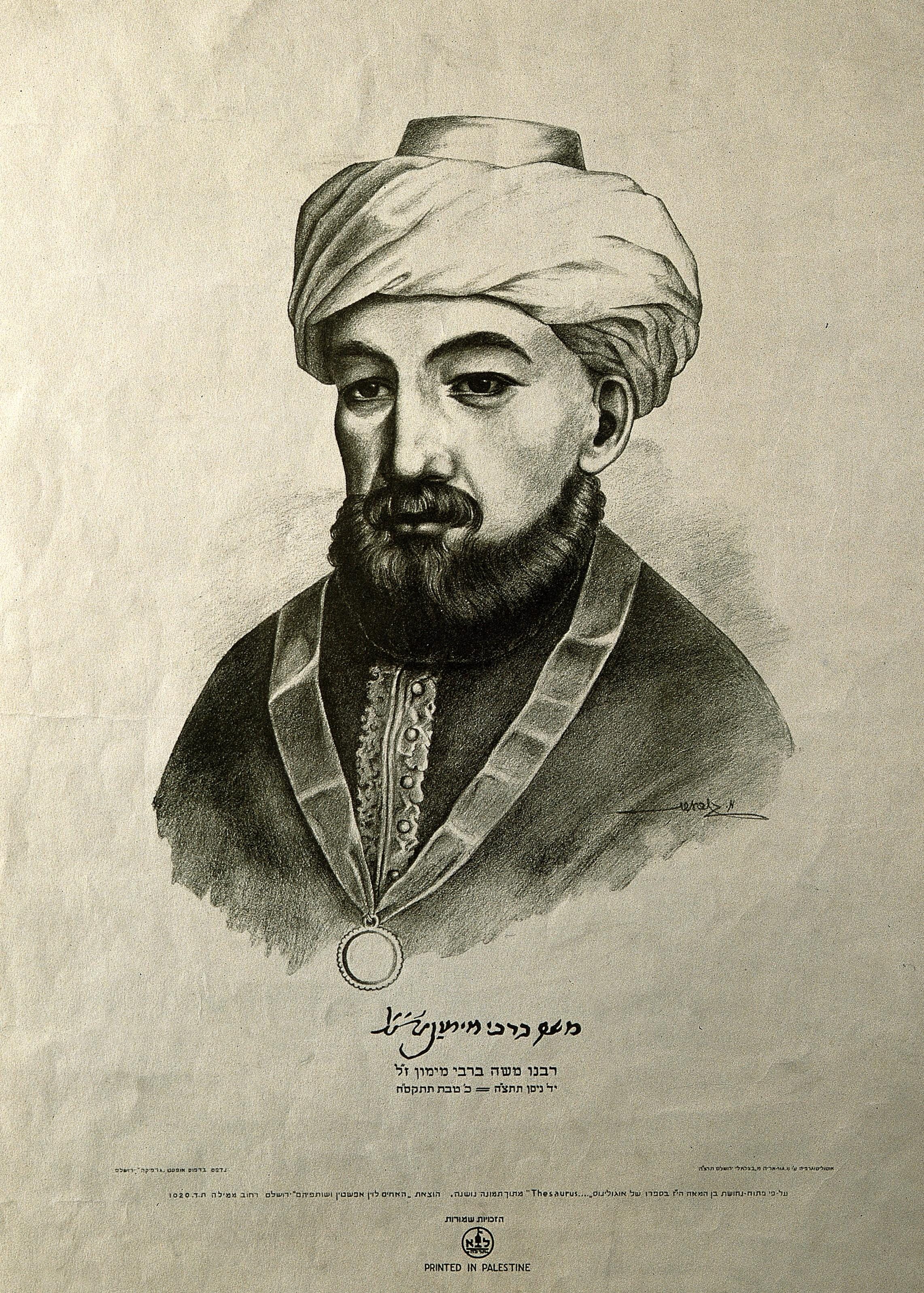
Maimonides belongs near the center of this argument because he models the humility the West often forgets.
He lived from 1138 to 1204, only a few years before Magna Carta was sealed in 1215. That timing places him in the same broad medieval world that later Western memory often separates too neatly into categories like “Islamic,” “Jewish,” “Christian,” and “European.” While England was moving toward one of its most famous legal documents, Maimonides was working in the Mediterranean world of Córdoba, Morocco, and Egypt, bringing together Scripture, rabbinic law, Aristotle, Arabic philosophy, Islamic intellectual culture, medicine, theology, and legal reasoning. The National Archives dates Magna Carta to June 15, 1215, and Brandeis describes Maimonides as “the most significant Jewish intellectual of the Islamic world.”
Magna Carta did not arise in a world where Europe alone was thinking about law, limits, authority, obligation, reason, and justice. Across the Mediterranean, Jewish, Islamic, and Christian thinkers were already wrestling with law, revelation, philosophy, medicine, governance, and the ordering of communal life.
Maimonides represents a faithful mind disciplined enough to receive, test, interpret, and synthesize across traditions without surrendering his own covenantal identity.
That is humility of knowing that truth is not tribal property.
His life helps us see how misleading the later Western story can become. Magna Carta is often treated as a purely Western milestone, and it is certainly central to English legal memory. But the broader medieval world was not intellectually silent outside England. Maimonides had already shown that law and reason, faith and philosophy, medicine and theology, Scripture and inherited wisdom could be held together with extraordinary seriousness.
So when we place Maimonides beside Magna Carta chronologically, we are not trying to erase England’s contribution. We are restoring proportion. England was not alone on the stage of history. The Mediterranean world was alive with legal, philosophical, theological, and scientific thought before, during, and after the moment English barons forced King John to accept limits at Runnymede.
Maimonides reminds us that wisdom was not waiting for England to begin.
It was already moving through Córdoba, Fez, Cairo, Fustat, Jewish courts, Arabic texts, medical practice, rabbinic reasoning, Aristotelian philosophy, and the wider world of Mediterranean exchange.
That is exactly the kind of humility this essay is trying to recover.
Augustine Was African Before He Was “Western.” He has to be rescued from the flattened category of “Western father.”
Augustine lived from 354 to 430 AD and was a North African bishop, born in present-day Algeria and later bishop of Hippo. His world was Roman, African, Mediterranean, Christian, Latin-speaking, shaped by Neoplatonism, and associated with Manichaeism for about nine years before his conversion.
Johannes van Oort’s scholarly work notes that Augustine was a Manichaean from roughly his nineteenth to twenty-eighth year, and Cambridge scholarship treats Manichaeism as a significant part of Augustine’s religious and intellectual context.
That matters because Manichaeism arose in the Persian and Sasanian world. Augustine later rejected it, of course, but his intellectual journey already disrupts any clean Western story. He moved through North African Christianity, Latin rhetoric, Roman imperial culture, Manichaean dualism, Neoplatonism, Ambrose’s preaching in Milan, Scripture, and the lived church.
Augustine is not less important because of this.
He is more interesting.
He shows that what later gets called Western Christianity was already African, Mediterranean, Roman, Eastern-facing, and intellectually entangled.
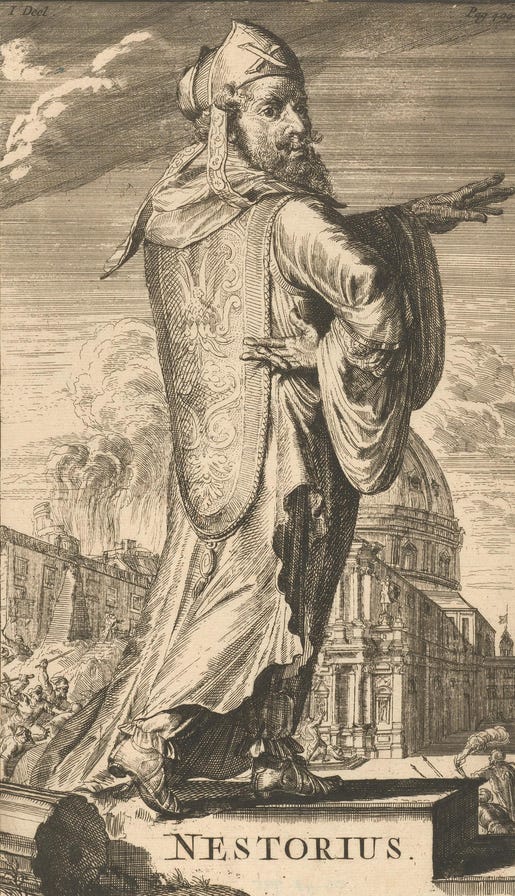
Nestorius and the River That Was Pushed East
Nestorius belongs here too, not because we need to flatten the Christological controversy, but because his story reveals how doctrine, empire, politics, and institutional authority can become entangled.
The theological questions around Christ and Mary mattered deeply. The church had to speak faithfully about the union of Christ’s divinity and humanity. The title Theotokos, “God-bearer,” was not a small issue. But the way Nestorius was condemned at Ephesus in 431 also unfolded amid imperial summons, ecclesiastical rivalry, and struggles between major sees.
Claremont’s Coptic Encyclopedia entry describes the Council of Ephesus as summoned by Theodosius II to settle the Nestorian controversy and places the conflict in the rivalry involving Cyril of Alexandria and Nestorius of Constantinople.
We do not need to flatten the Christological issue.
But we also should not flatten the man.
Nestorius has often been reduced to a label in the Western Christian imagination. His name became a warning sign, a theological category, a shorthand. Later traditions inherited the accusation while often forgetting the human being, the setting, and the consequences.
One of those consequences was enormous.
Syriac-speaking Christian traditions associated with the Church of the East moved outside Roman imperial control, especially into Persia and then across Asia. Yale Scholarship Online describes the Syriac world as a forgotten Christianity whose missionaries founded churches from the Mediterranean coast to Persia, Central Asia, India, and China.
That is not marginal history.
That is part of the main river.
This becomes critically important during the Abbasid translation movement centered in Baghdad from roughly the eighth through tenth centuries. Greek medicine, philosophy, mathematics, astronomy, and science were preserved, translated, commented on, and expanded in Syriac and Arabic. Hunayn ibn Ishaq, who lived from 808 to 873, was one of the major translators of Greek learning into Syriac and Arabic.
This was not medieval England preserving Aristotle alone.
This was Syriac Christianity, Persian intellectual culture, Arabic scholarship, Jewish learning, and Islamicate patronage preserving and expanding bodies of knowledge that Western Europe would later recover.
Cyrus, the Persian Interruption
Cyrus may be the most disruptive figure of all.
The West often crowns its imagination with Arthur, Camelot, sacred swords, chosen kings, Shakespeare, classical education, and imperial destiny. Some of those stories are beautiful. But Scripture gives us something more startling.
Isaiah names Cyrus, a Persian king, as the Lord’s anointed.
Lisbeth Fried’s article in Harvard Theological Review, “Cyrus the Messiah? The Historical Background to Isaiah 45:1,” states the point directly: according to Isaiah 45:1, Cyrus is YHWH’s anointed, His Messiah. Bible Odyssey similarly identifies Cyrus the Great as the Persian king whom Isaiah 45 calls Yahweh’s anointed.
That should matter more than it usually does.
Cyrus is not European. He is not Greek. He is not Roman. He is not British. He is Persian. Yet God uses him in the biblical story as an instrument of restoration. He releases the exiles and opens the way for return.
That fact alone unsettles every narrow civilizational account of God’s work.
The Bible does not wait for Arthur.
The Bible names Cyrus.
This also complicates the American story.
The United States did not begin as Britain continued. It began by rejecting British rule. The founders inherited British law, but their intellectual world was wider than Britain. They read Scripture, Rome, Greece, Enlightenment political thought, Protestant resistance theory, and ancient examples of rule and leadership.
Thomas Jefferson’s intellectual world was not merely British. The Library of Congress notes that Jefferson owned at least two copies of Xenophon’s Cyropaedia, a Greek work about Cyrus the Great, the Persian emperor. Richard Nelson Frye’s essay on Jefferson and Cyrus also notes the presence of the Cyropaedia in the libraries of founders such as Jefferson, Adams, and Franklin, while caution is still needed about how direct the influence was.
That does not mean Cyrus wrote the Constitution.
It means Cyrus was not absent.
He was present in Scripture, present in Greek political literature, and present in the library of one of the major American founders. Yet the Persian thread is often discounted because the simpler story prefers Greece to Rome to Britain to America.
Even the scholarly handling of Xenophon can reveal the problem.
Scholars are right to say that Cyropaedia is not simple biography. Xenophon’s Cyrus is literary, philosophical, political, and educational. It belongs partly to the tradition of forming rulers. But if Cyrus is only allowed to matter when safely contained inside Greek classics, while the Persian king himself disappears, then scholarship has repeated the same pattern: receive, reclassify, possess.
Cyrus becomes acceptable as Xenophon’s subject.
Cyrus becomes less acceptable as a Persian disruption of the Western story.
This is where a Schaeffer-like narrative needs correction. Schaeffer saw the danger of a West losing biblical truth, but his frame can still leave readers imagining that Christianity and the West are almost coextensive. Cyrus breaks that frame from inside Scripture itself. A Persian king is named as God’s anointed before Britain, Oxford, Cambridge, Shakespeare, the medieval Vatican, the Reformation, or America existed.
That is not a footnote.
It is a theological interruption.
Shakespeare and the Fruitfulness of Inheritance
Shakespeare belongs in this same essay, not as a target, but as evidence that greatness often comes through received inheritance.
England often treats Shakespeare as one of the purest expressions of its own genius, and in many ways he is. His language, dramatic instinct, psychological depth, humor, tragedy, and moral imagination are extraordinary. But Shakespeare did not emerge from nowhere, and English literature was not born out of untouched English soil.
Shakespeare inherited a world already filled with older stories. He drew from Roman history, Greek drama, biblical language, medieval chronicles, Italian novellas, classical mythology, English folk memory, Christian moral imagination, and the political anxieties of his own time.
That does not make Shakespeare less great.
It makes his greatness more honest.
He was not a solitary English mountain rising out of nowhere. He was a genius working within inheritance. He received stories, languages, forms, symbols, moral tensions, and civilizational memories, then transformed them through his own astonishing gift.
Shakespeare is not evidence that civilizations self-generate.
He is evidence that received inheritance can become fruitful when it is imaginatively transformed.
Rome, Reform, and the Temptation to Possess
The Vatican also belongs in this story.
Rome preserved, organized, patronized, disciplined, taught, and transmitted enormous cultural and theological power. But the Vatican did not become powerful simply because it possessed truth in some pure, untouched form. It became powerful because it stood at the intersection of theology, imperial collapse, land, law, literacy, administration, sacramental authority, political negotiation, and institutional memory.
As the Western Roman Empire weakened, the church became one of the few institutions capable of continuity. Bishops became organizers. Monasteries became libraries. Clergy became administrators. The papacy gradually accumulated spiritual, legal, cultural, and political authority.
Again, that does not make everything false.
It makes the story human.
The church preserved many gifts, but it also learned to possess them. It stewarded truth, but at times confused stewardship with ownership. It guarded doctrine, but also accumulated power. It served Christ, but also became entangled with empire, wealth, hierarchy, and control.
That is not a reason to despise Rome.
It is a reason to tell the truth about spiritual temptation.
The Reformation belongs in the same pattern. It was not simply a heroic Western achievement. It was also a correction of Roman institutional arrogance, indulgence systems, ecclesiastical centralization, and financial corruption. Rome had begun confusing stewardship with possession.
Yet Protestants later developed their own forms of civilizational pride. They rightly challenged Rome’s corruption and overreach, but at times began to speak as though Christianity had simply passed from Roman possession into Protestant European possession. The same temptation remained, only dressed in different clothing.
The Gospel belongs to Christ.
God is not owned by Rome, Europe, Britain, America, technological modernity, or the newest promises of artificial intelligence. Every age is tempted to imagine itself as the true guardian of truth, history, progress, or divine favor. But the kingdom of God cannot be absorbed into any civilization, institution, empire, nation, ideology, or machine.
Awe, Gratitude, and the Recovery of Truth
This is where Abraham Joshua Heschel helps restore the proper posture.
Heschel warned that modern people could become technically sophisticated while losing wonder. His importance here is not merely biographical. It is moral and spiritual. He reminds us that information is not wisdom, and that a civilization can become highly organized while becoming inwardly thin.
A person can possess information and still lack wisdom. A civilization can build universities and still lose gratitude. A church can guard doctrine and still forget reverence. An empire can preserve books and still mistake stewardship for ownership.
That is why both Harari and Schaeffer need correction.
Harari sees the network, but his vision often loses the soul. Schaeffer sees the danger of losing the soul, but his frame often narrows the network. Paul widens the whole imagination by dethroning boasting before Christ. Maimonides shows the humility of a faithful mind that can receive wisdom across traditions without losing its covenantal center. Heschel brings the argument back to awe. Cyrus interrupts the Western fantasy from inside Scripture itself. Augustine reminds us that even a so-called father of Western Christianity was formed in Africa, Rome, Manichaeism, Neoplatonism, and the wider Mediterranean world. Nestorius and the Syriac East show that what was pushed to the margins often carried the river forward. Aquinas shows that genius does not have to be self-generated to be real. Aristotle shows that what Europe later claimed had already traveled through many hands before it arrived.
The point is not to cut down the West but to help tell the whole story.
The West has greatness, but it is received greatness.
Christianity is not Western property. Aristotle did not belong to Britain. Augustine cannot be reduced to northern Europe. Aquinas does not prove Western self-generation. Shakespeare does not prove that England created itself. Oxford and Cambridge are not pure extensions of Athens, the Vatican is not the owner of the Gospel, and America is not simply Britain continued across the Atlantic.
The phrase “Western civilization” can still be used, but only if it is humbled by the truth of how much it received.
The West did not create the river.
It entered the river downstream.
And once that is remembered, the proper response is no longer civilizational boasting. It is gratitude.
Sources and Further Reading
Biblical Texts
Isaiah 45
Ezra 1
Acts 17
Galatians 3
1 Corinthians 13
Christianity as Global and Eastern Before Western
Robert Louis Wilken, The First Thousand Years: A Global History of Christianity, Yale University Press.
Yale’s description emphasizes Christianity’s movement from the Mediterranean through the Middle East to Central Asia, India, and China.
Syriac Christianity and the Church of the East
Françoise Briquel Chatonnet and Muriel Debié, The Syriac World: In Search of a Forgotten Christianity, Yale Scholarship Online.
Arabic-Islamic Influence on Latin Philosophy
Dag Nikolaus Hasse, “Influence of Arabic and Islamic Philosophy on the Latin West,” Stanford Encyclopedia of Philosophy.
Averroes
“Ibn Rushd [Averroes],” Stanford Encyclopedia of Philosophy.
Maimonides
Brandeis University course description on Maimonides as “the most significant Jewish intellectual of the Islamic world.”
Sarah Stroumsa, Maimonides in His World: Portrait of a Mediterranean Thinker.
Augustine and Manichaeism
Johannes van Oort, “The Young Augustine’s Knowledge of Manichaeism.”
Augustine in Context, Cambridge University Press, chapter on Manichaeism.
Nestorius and Ephesus
Claremont Coptic Encyclopedia entry on the Council of Ephesus, 431.
Cyrus in Isaiah
Lisbeth S. Fried, “Cyrus the Messiah? The Historical Background to Isaiah 45:1,” Harvard Theological Review.
Bible Odyssey article on Cyrus as Yahweh’s anointed.
Jefferson and Cyrus
Library of Congress article on Jefferson’s copies of Xenophon’s Cyropaedia.
Richard Nelson Frye, “Jefferson and Cyrus.”
Oxford and Cambridge
University of Oxford official history, noting teaching existed in some form by 1096.
University of Cambridge official history, noting its early thirteenth-century origins.
Modern Conversation Partners
Yuval Noah Harari, Nexus: A Brief History of Information Networks from the Stone Age to AI, Random House, 2024. Harari’s book provides the modern information-network framework that this essay engages and critiques.
Francis A. Schaeffer, How Should We Then Live? The Rise and Decline of Western Thought and Culture, originally published in 1976. Schaeffer provides the Western Christian civilizational frame that this essay appreciates but also challenges.
Abraham Joshua Heschel, God in Search of Man: A Philosophy of Judaism, originally published in 1955, and The Sabbath. Heschel provides the language of awe, wonder, reverence, and spiritual perception that helps correct both technocratic reductionism and civilizational pride.
You could also include this optional final line:
Primary Texts Worth Reading Alongside This Essay
Xenophon, Cyropaedia
Augustine, Confessions
Maimonides, Guide for the Perplexed
Thomas Aquinas, Summa Theologiae
Francis Schaeffer, How Should We Then Live?
Yuval Noah Harari, Nexus
Abraham Joshua Heschel, God in Search of Man