The First Fruit Named

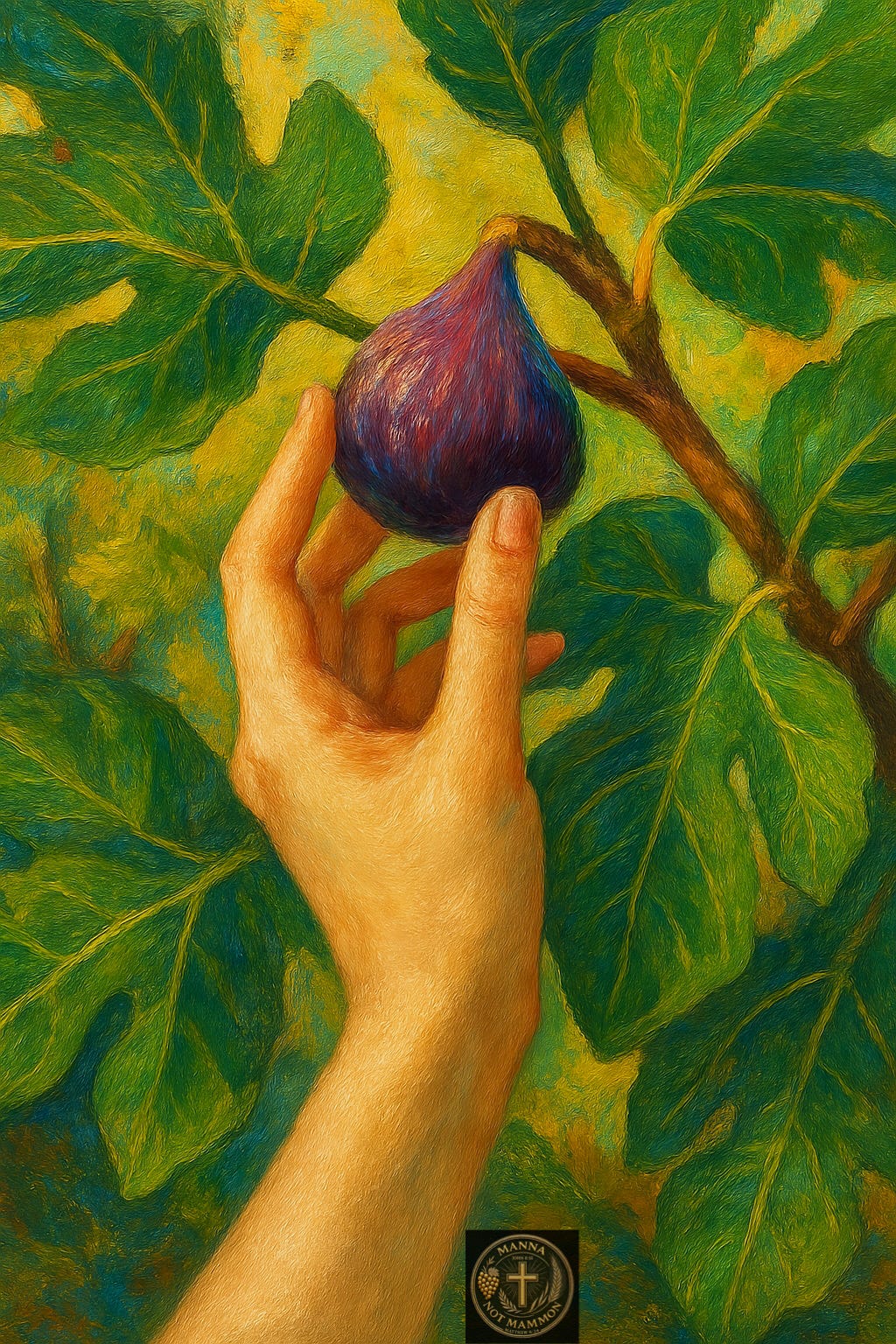
We are never told explicitly what the fruit was. Genesis simply refers to “the fruit of the tree which is in the midst of the garden” (Genesis 3:3). The species remains unnamed, and Scripture offers no botanical clarification. Yet it is striking that the first fruit actually identified in the biblical narrative is the fig, specifically its leaves.
After eating…..
“the eyes of both were opened, and they knew that they were naked; and they sewed fig leaves together and made themselves loincloths” (Genesis 3:7).
The first named fruit in Scripture is tied not only to the fall itself but to humanity’s immediate response to shame. Before there is reconciliation, there is concealment. The instinct is to cover exposure through self-made provision.
Some of the rabbis noticed the irony. Whether or not the forbidden fruit was a fig, what may have been associated with the transgression becomes the material used in the attempt to manage its consequences. The human response to rupture is not yet repentance but self-covering.
The narrative then turns.
“And the LORD God made for Adam and for his wife garments of skins and clothed them” (Genesis 3:21).
The text does not elaborate, but the movement is unmistakable. The covering fashioned by human hands is replaced by one given by God Himself. That shift gestures forward toward sacrifice, toward atonement, and toward the long redemptive arc that unfolds through Torah, prophets, and ultimately the person of Christ.
If one were to speak in terms of likelihood rather than certainty, fig remains one of the stronger candidates for the forbidden fruit, perhaps in the forty to fifty percent range.
Pomegranate, another fruit native to the region and deeply embedded in Israel’s symbolic world, might follow at roughly twenty percent.
Apple, though dominant in Western imagination, is far less likely. Its prominence arises largely from the Latin word malum, which can mean both “evil” and “apple,” a linguistic overlap later reinforced by Renaissance art. The Hebrew text itself gives no such indication.
The fig, however, carries unusual weight in the biblical and Middle Eastern world. It was not ornamental. It was staple sustenance, eaten fresh and dried, pressed into cakes, stored for winter, and widely traded. A mature fig tree symbolized stability and blessing. To sit under one’s vine and fig tree signified settled covenant peace. Micah envisions restoration in these words:
“They shall sit every man under his vine and under his fig tree, and no one shall make them afraid” (Micah 4:4).
Jeremiah uses baskets of good and bad figs to describe Israel’s spiritual condition (Jeremiah 24). Fruit becomes covenant language. In the Gospels, the symbolism intensifies. Jesus approaches a fig tree seeking fruit and finds none, enacting a parable of unfruitfulness (Mark 11:12–14). In Luke 13 He tells of a fig tree given three years to bear fruit:
“A man had a fig tree planted in his vineyard, and he came seeking fruit on it and found none. And he said to the vinedresser, ‘Look, for three years now I have come seeking fruit on this fig tree, and I find none. Cut it down. Why should it use up the ground?’And he answered him, ‘Sir, let it alone this year also, until I dig around it and put on manure. Then if it should bear fruit next year, well and good; but if not, you can cut it down’”
(Luke 13:6–9).
The fig tree is given time… it is cultivated and tended.
Mercy delays judgment. Many have noted how closely those three years echo the span of Jesus’ public ministry. The owner seeks fruit; the gardener intercedes. The imagery is covenantal and patient.
The fig also appears at a moment of recognition. When Philip tells Nathanael about Jesus, Nathanael is skeptical. Yet Jesus says of him,
“Behold, an Israelite indeed, in whom there is no deceit” (John 1:47).
The word translated “deceit” recalls Jacob’s earlier grasping before he became Israel. Nathanael is described as a true Israelite without guile. Jesus then adds,
“Before Philip called you, when you were under the fig tree, I saw you” (John 1:48).
In a culture where sitting under a fig tree symbolized meditation and covenant hope, the image is layered. The fig that once marked concealment now becomes the setting of revelation. One who does not grasp is seen and known.
There is also a historical irony. In Renaissance Europe, artists frequently added fig leaves to classical statues to cover nudity. Some leaves were even detachable, designed to conform to shifting standards of modesty. The fig leaf reappears as a literal instrument of concealment. Even in art, the impulse persists. We still reach for leaves.
Whether the fruit in Eden was a fig cannot be proven. But the fig’s presence across the canon, and its cultural significance in the ancient world, make the symbolism difficult to dismiss. In Genesis, fig leaves are stitched together in response to shame. In the prophets, figs represent covenant faithfulness or corruption. In the ministry of Jesus, the fig tree becomes a measure of fruitfulness and a sign of patient mercy. In John’s Gospel, it becomes the place of recognition for an Israelite without deceit.
The fall begins with grasping and with an attempt to manage nakedness through self-made covering. Redemption unfolds as God Himself clothes His people. What begins in Genesis with garments of skin reaches its fullness in Revelation:
“They have washed their robes and made them white in the blood of the Lamb”
(Revelation 7:14)
Paul speaks in similar covenantal language when he writes,
“For as many of you as were baptized into Christ have put on Christ” (Galatians 3:27)
The botanical question remains open. The theological movement does not. Scripture traces a coherent arc from self-covering to divine covering, from concealment to infinite loving grace.
There is something deeply beautiful in that continuity.