The Companion at the Table
Abiding, Manna, and the Love Bond That Carries a Life

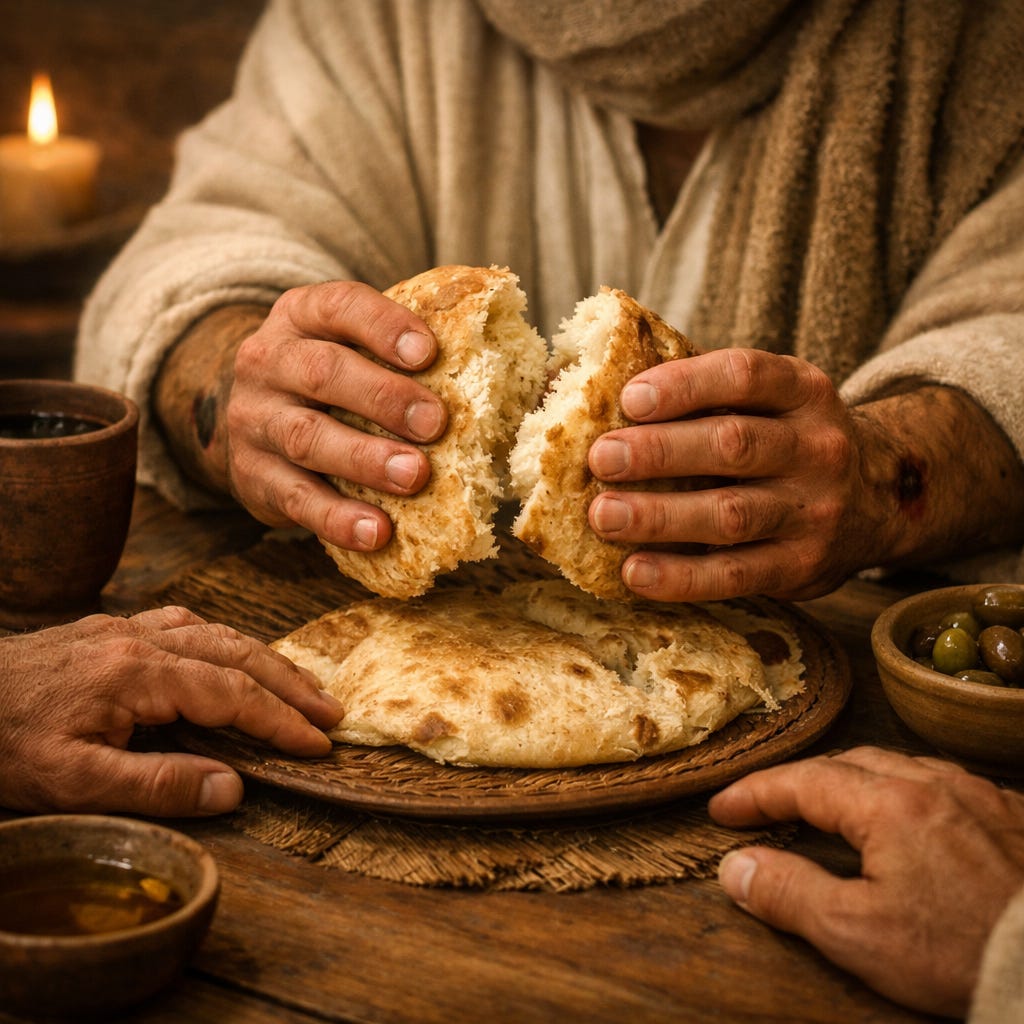
And in sharing bread as companions, their eyes were opened.
“When He was at the table with them, He took the bread and blessed and broke it and gave it to them. And their eyes were opened, and they recognized Him.” (Luke 24:30–31)
Companion comes from the Latin, meaning one who shares bread.
The Companion at the Table
Abiding, Manna, and the Love Bond That Carries a Life
There is a moment in the Gospels that has always stayed with me as it gently exposes what I assume about security and discipleship.
A scribe approaches Jesus and proclaims the desire to follow Him wherever He goes with sincerity and boldness, yet Jesus responds without reassurance or explanation.
“Foxes have holes, and birds of the air have nests, but the Son of Man has nowhere to lay his head.” (Matthew 8:20; Luke 9:58)

Red Fox….Photograph by my brother-in-law. Winter woods, Pennsylvania.
When placed alongside other teachings of Jesus that emphasize God’s care, this sounds like instability, even deprivation……
In the Sermon on the Mount, Jesus speaks directly to anxiety and the fear of provision, proclaiming the reality that the created world as a living testimony to the Father’s attentiveness and care.
“Therefore I tell you, do not be anxious about your life, what you will eat or what you will drink… Look at the birds of the air: they neither sow nor reap nor gather into barns, and yet your heavenly Father feeds them.” (Matthew 6:25–26)
These passages can feel as though they pull in opposite directions, one naming exposure and uncertainty, the other promising care and provision, but I don’t think Jesus is offering competing visions of the life of faith.
I think He is relocating the source of security altogether. The question is not whether there will be resistance or unpredictability along the way, but what is the foundation and anchor of life as we traverse it.
Jesus is not glorifying hardship or presenting instability in His admonition to the scribe but addressing expectations.
Following Him is not something that can be layered onto an already secured life without counting the cost or examining the foundation beneath it. Jesus is explicit about this.
Discipleship is not an accessory to stability; it is a re-anchoring of life itself. This is where the language of manna becomes so important.
In Scripture, manna is not about scarcity but consistency, and all sufficient consistent daily provision.
Rather than something to be stored or controlled, It teaches a people to live without the constant fear that His loving and kind provision is not enough.
Manna does not remove the wilderness, but it removes the panic that the wilderness will destroy us.
Abiding in the Manna
Jesus lives in that same manna state, not only receiving provision, but being provision.
He moves through the world dependent, relational, traveling light, yet knowing He’s never uncovered or unsheltered.
He who dwells in the shelter of the Most High will abide in the shadow of the Almighty.—Psalm 91:1
He receives hospitality, eats in the homes of others, sleeps in borrowed places, and entrusts His life to provision that arrives person by person rather than through accumulation.
His lack of a place to lay His head is not a sign of neglect, but a revelation of where His confidence rests. His life is covered, even when it is not cushioned.
And Jesus makes this explicit. He does not merely live by manna. He identifies Himself as manna.
“I am the bread of life.
Whoever comes to Me shall not hunger, and whoever believes in Me shall never thirst.”
(John 6:35)
The manna in the wilderness was never meant to become a stored system. It was a daily relationship.
In the same way, Jesus does not offer Himself as a resource to be stockpiled, but as a life to be received and lived within. To abide in Him is to live nourished, not by foresight or control, but by ongoing communion.
This is not a metaphor layered on top of His ministry. It is the shape of it.
This is also where Paul becomes such a faithful echo of Jesus rather than a later theological adjustment.
Paul’s letters are written from within pressure, movement, and loss, yet they consistently reflect a settled interior life shaped by trust rather than vigilance. Writing to the Philippians from prison, Paul says:
“I have learned in whatever situation I am to be content.
I know how to be brought low, and I know how to abound.
In any and every circumstance, I have learned the secret
of facing plenty and hunger, abundance and need.”
(Philippians 4:11–12)
Paul is not describing emotional detachment or stoic resolve.
He is describing a nervous system retrained by relationship. Contentment here is not passive resignation. It is the fruit of knowing that one’s life is being carried, even when circumstances remain unstable.
He names the source of that stability clearly:
“I can do all things through Him who strengthens me.”
(Philippians 4:13)
This strength does not come from stored security or predictive control. It comes from abiding connection.
Paul’s life is not free of threat. But it is free of the constant fear response that arises when one believes everything depends on personal management.
Jesus gives language to this same reality on the night before His death:
“Abide in Me, and I in you.
As the branch cannot bear fruit by itself, unless it abides in the vine, neither can you, unless you abide in Me.” (John 15:4)
Abiding is not a retreat from work or responsibility, nor is it a passive stance toward life. It names a way of living in which effort flows from attachment rather than anxiety, where fruitfulness emerges not from striving but from remaining connected to the source of life itself. Pruning still takes place, and growth still costs something, but the work is no longer driven by fear or the need to secure oneself.
What I’ve always loved about the word abide is how much it carries. In English it suggests remaining, dwelling, and staying, but it also resonates deeply with the Hebrew word avodah, which holds together the meanings of cultivating, serving, tending, and worshiping. In Genesis, humanity’s first vocation is described using this language: to cultivate and keep the garden. Work, from the beginning, was not meant to be frantic labor for survival, but attentive care offered within relationship.
In John 15, Jesus draws us back into that original vocation. He speaks of the Father as the gardener and of Himself as the vine, placing us not in the position of anxious laborers trying to force fruit, but as branches learning how to remain connected while being shaped. When abiding and avodah are held together in this way, work itself becomes an act of worship, and fruitfulness emerges not through pressure or striving, but as the natural overflow of staying close.
This is the shift Jesus invites His disciples into, and it is the same shift Paul learned over time.
Not a life without resistance, but a life without the constant sense that disaster is waiting just around the corner. Not a life of control, but a life of coverage. Not certainty about circumstances, but confidence in a Father.
To abide in Christ is to live in the manna state — feeding on the One who gives Himself daily, expecting provision without hoarding, allowing peace to replace vigilance. Work and effort shall remain, yet both are held inside trust rather than fear.
It is to lay your head down, not always knowing where you will sleep next, but knowing whose life you are living inside.
That phrase matters.
George Benson once sang, “I’m living inside your love,” and while the song comes from a different register, the image itself is quietly right. To live inside love is not sentimentality or escape. It suggests enclosure and coverage, a life held within something more durable than circumstance, something that does not collapse when conditions shift.
“For in Him we live and move and have our being.”— Acts 17:28
“For You are my refuge, a tower of strength against the enemy. Let me dwell in Your tent forever; let me take refuge in the shelter of Your wings.”— Psalm 61:3–4
“Keep me as the apple of Your eye; hide me in the shadow of Your wings.”— Psalm 17:8
“One thing I have asked from the LORD, that I shall seek: that I may dwell in the house of the LORD all the days of my life.”— Psalm 27:4
That is what Jesus is naming when He says, “Abide in Me.” He is not describing a momentary connection or a spiritual technique. He is describing a way of remaining, of living from within a relationship rather than managing life from the outside. Abiding is not about performance or control, but about staying connected to the source from which life actually flows.
Over the course of a lived human life, this is the kind of security that endures. Not because we learned to manage uncertainty or control outcomes, but because we remained connected to the One who carries the story from beginning to end, the Author and Sustainer whose faithfulness holds even when ours falters.
Wow. I missed this earlier but I really needed it right now. Manna from heaven. Thank you.