Looking at the World at Low Power
A pathologist’s reflections on America, architecture, and the world beneath the headlines

Fifty Years in America
This year has special meaning for me.
Fifty years ago, in 1976, I left Iran and came to the United States. It was America’s Bicentennial, and I arrived as a young immigrant with my family in a country celebrating two hundred years of independence. I still remember our community coming together to celebrate, decorating streets and even painting the fire hydrants with patriotic colors and Bicentennial themes.
One of the first things that struck me was something I had never really noticed before: there were no walls around the homes. As a young boy, I could get on my bicycle and ride for hours through the neighborhood, exploring streets, parks, and trails with a sense of freedom that was entirely new to me. There was an openness to the community….a quiet confidence that invited children outdoors to roam, discover, and simply enjoy being young. I experienced a wonderful freedom every time I climbed onto my bike and rode through a neighborhood that felt open, welcoming, and safe.
As America celebrates its 250th birthday, I find myself reflecting on those fifty years with profound gratitude.
This nation welcomed me, educated me, gave me the opportunity to become a physician, raise a family, pursue ideas freely, and build a life I could never have imagined as a young immigrant arriving from another part of the world.
Like every nation, America possesses remarkable strengths and undeniable imperfections. Loving a country does not require pretending it is flawless. On the contrary, gratitude frees us to see it honestly…..to celebrate what is noble, acknowledge what needs improvement, and work to preserve what makes it worthy of love.
2. Begin at Low Power
Friends sometimes ask my opinion about my thoughts on the events currently going on in the country of my birth…. Iran.
In many ways, my training as a pathologist has shaped the way I approach those questions.
One of the first disciplines pathology teaches is not to begin with the most magnified view. We begin by orienting ourselves to the slide, studying its architecture, its patterns, and the relationships between its parts. Only after the whole begins to make sense do we move closer to examine the individual cells. At high power there is an abundance of detail, but without first understanding the architecture, that detail can be confusing—or even misleading. In pathology, the details are not the starting point; they are the destination.
That discipline has quietly shaped the way I read Scripture, study history, think about economics, understand relationships, and view geopolitics. Again and again, I have found that understanding comes not from seeing more details, but from seeing how the details fit within the larger whole.
Most conversations about the world begin with the headlines—Iran, Ukraine, China, Taiwan, oil, tariffs, the Red Sea. These matter, of course. But they are like cells viewed at high power: rich in detail, compelling in their own right, yet difficult to interpret until the deeper architecture comes into view.
That is the purpose of these reflections. Before examining the headlines, I want to step back and look at the architecture that gives them meaning.
3. The Architecture Beneath the Headlines
The first pattern that comes into view is the architecture of the postwar international order.
Long before the United States became the dominant global power, Britain, an island nation understood the sea.
Its survival and prosperity depended on ships, ports, trade routes, finance, insurance, and naval power. The British Empire is better understood as maritime system rather than simply territory.
The main gates of the system were ….Gibraltar. Malta, Suez, Aden, Singapore, and Hong Kong.
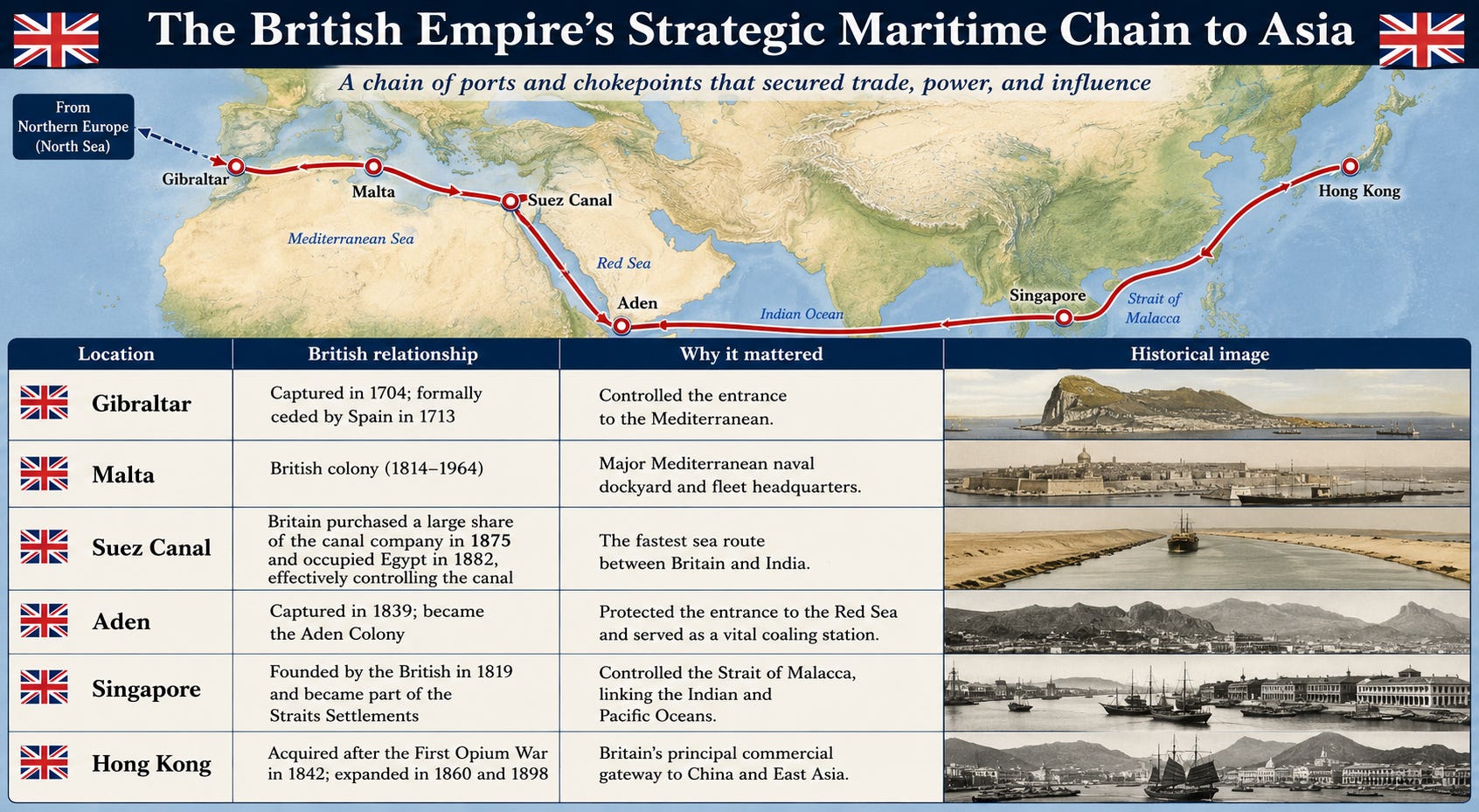
Britain understood that prosperity depends on the secure and predictable movement of ships, cargo, and capital from port to port, while relentlessly mitigating the risks that could disrupt that flow.
After the Second World War, Britain was exhausted. The United States emerged with unmatched industrial capacity, financial strength, and naval reach. It inherited much of the global system Britain had built and then expanded it.
But the system carried an internal tension. Under Bretton Woods, the United States had promised foreign governments that the dollars they accumulated could be exchanged for gold at a fixed price of $35 an ounce. At the same time, the world needed an expanding supply of dollars to finance reconstruction, investment, and international trade.
Over the following decades, the US sent increasing quantities of those dollars abroad. The Korean War, permanent military bases, foreign aid, Cold War alliances, and eventually the war in Vietnam all required enormous overseas expenditures. The space race and the expansion of domestic programs added further pressure to the federal budget and contributed to inflation, although they did not directly drain gold in the same way as spending abroad. American corporations were also investing overseas, while the US was importing increasing quantities of foreign goods. The result was a persistent balance-of-payments deficit: more dollars were accumulating outside the US than were returning.
As foreign central banks accumulated those dollars, some began exchanging them for American gold. By the late 1960s, the United States had issued far more dollar claims than it could realistically redeem at the promised price. The Vietnam War intensified the problem, but it was not the only cause; it accelerated a structural weakness that had been developing since the early years of the Cold War. Faced with the possibility of a run on the remaining gold reserves, President Richard Nixon closed the gold window in August 1971. The dollar would no longer be convertible into gold.
The oil crisis of 1973 then forced the United States to strengthen the dollar’s place in a different way. Secretary of State Henry Kissinger approached Saudi Arabia primarily as a geopolitical strategist. Following the Arab oil embargo, he sought to deepen the relationship between Washington and the Saudi monarchy through diplomacy, security cooperation, arms sales, economic development, and a shared interest in maintaining stable oil supplies. Treasury Secretary William Simon handled much of the financial architecture, helping establish the United States–Saudi Arabian Joint Commission on Economic Cooperation and encouraging Saudi Arabia to invest its rapidly growing oil revenues in American securities and businesses.
Because international oil was generally priced in dollars, every country needing oil also needed access to dollars. Saudi Arabia and the other oil exporters then placed much of their surplus dollar revenue—often called “petrodollars”—into American banks, Treasury securities, weapons purchases, infrastructure projects, and Western investments. This created a powerful cycle: the world bought dollars to purchase oil, and oil producers reinvested many of those dollars in the American financial system.
The dollar was not literally backed by oil in the way it had once been convertible into gold. Rather, the Saudi relationship reinforced a much broader foundation for the dollar: American military protection, secure energy flows, deep capital markets, Treasury debt, international trade, and the confidence that the United States remained at the center of the commercial and security order.
4. Finance, Insurance, and the Sea
Commerce rests on several interconnected layers.
One layer is finance.
Wall Street began not as an abstract symbol but as a physical marketplace in lower Manhattan. In 1792, twenty-four brokers signed the Buttonwood Agreement, establishing the organized securities market that eventually became the New York Stock Exchange. As the United States expanded, Wall Street developed into a central marketplace for government debt, corporate shares, credit, investment, and the movement of capital. It connected those who possessed money with governments and businesses that needed money to build, manufacture, trade, and expand.
Over time, “Wall Street” came to represent more than a street or a stock exchange. It represented the financial machinery behind economic power: banks that extend credit, bond markets that finance governments, investors who supply capital, and markets that allow money to move across industries and national borders.Lloyd’s of London reminds us that commerce depends on the ability to measure and price risk. Ships sail because cargoes can be insured. Banks finance trade because risk can be evaluated. Manufacturers plan because they can estimate costs.
Another layer is insurance.
Lloyd’s of London represents one of Britain’s most important contributions to the architecture of global commerce. It emerged in the late seventeenth century from Edward Lloyd’s coffee house, where merchants, shipowners, captains, and financiers gathered to exchange information about ships, cargoes, weather, wars, piracy, and distant ports. There, individuals willing to assume portions of a voyage’s risk helped turn uncertainty into something that could be measured, divided, and priced.
This system of marine insurance developed alongside Britain’s rise as a trading and naval power. The Royal Navy helped protect the sea routes, London’s banks financed trade, and Lloyd’s helped insure the ships and cargoes moving through them. Together, they formed a commercial architecture that allowed British trade—and eventually global trade—to operate across immense distances.
Insurance did not eliminate danger. It made danger financially manageable. A merchant could risk sending valuable cargo across an ocean, and a bank could finance the voyage, because the potential loss could be distributed among insurers rather than borne by one person or institution alone.
Lloyd’s therefore represents more than insurance. It represents Britain’s historic role in developing the institutions, practices, and information networks that made modern global commerce possible.
A third layer is maritime security.
Finance can provide the capital, and insurance can distribute the risk, but neither can keep a strait open, protect a convoy, or prevent a hostile power from disrupting trade.
For much of the nineteenth and early twentieth centuries, Britain’s Royal Navy performed that role across large parts of the world. After the Second World War, as British power receded, the United States assumed and greatly expanded much of that maritime responsibility. Together with allied and partner navies, it has helped protect many of the principal sea lanes through which oil, raw materials, manufactured goods, and food move.
The Fifth Fleet operates around the Persian Gulf, the Arabian Sea, the Red Sea, and the Strait of Hormuz.
The Sixth Fleet operates throughout the Mediterranean and the waters surrounding Europe and Africa.
The Seventh Fleet operates across the Western Pacific and into the Indian Ocean.
These fleets do not operate in isolation. They are sustained by a network of alliances, ports, bases, logistics hubs, and security agreements extending through Bahrain, Qatar, Kuwait, the United Arab Emirates, Italy, Spain, Japan, South Korea, Singapore, and many other strategically positioned locations.
Place those locations on a map and a pattern begins to emerge. They form a chain around the world’s most important maritime corridors and chokepoints…… narrow passages through which a remarkable share of global commerce must travel.
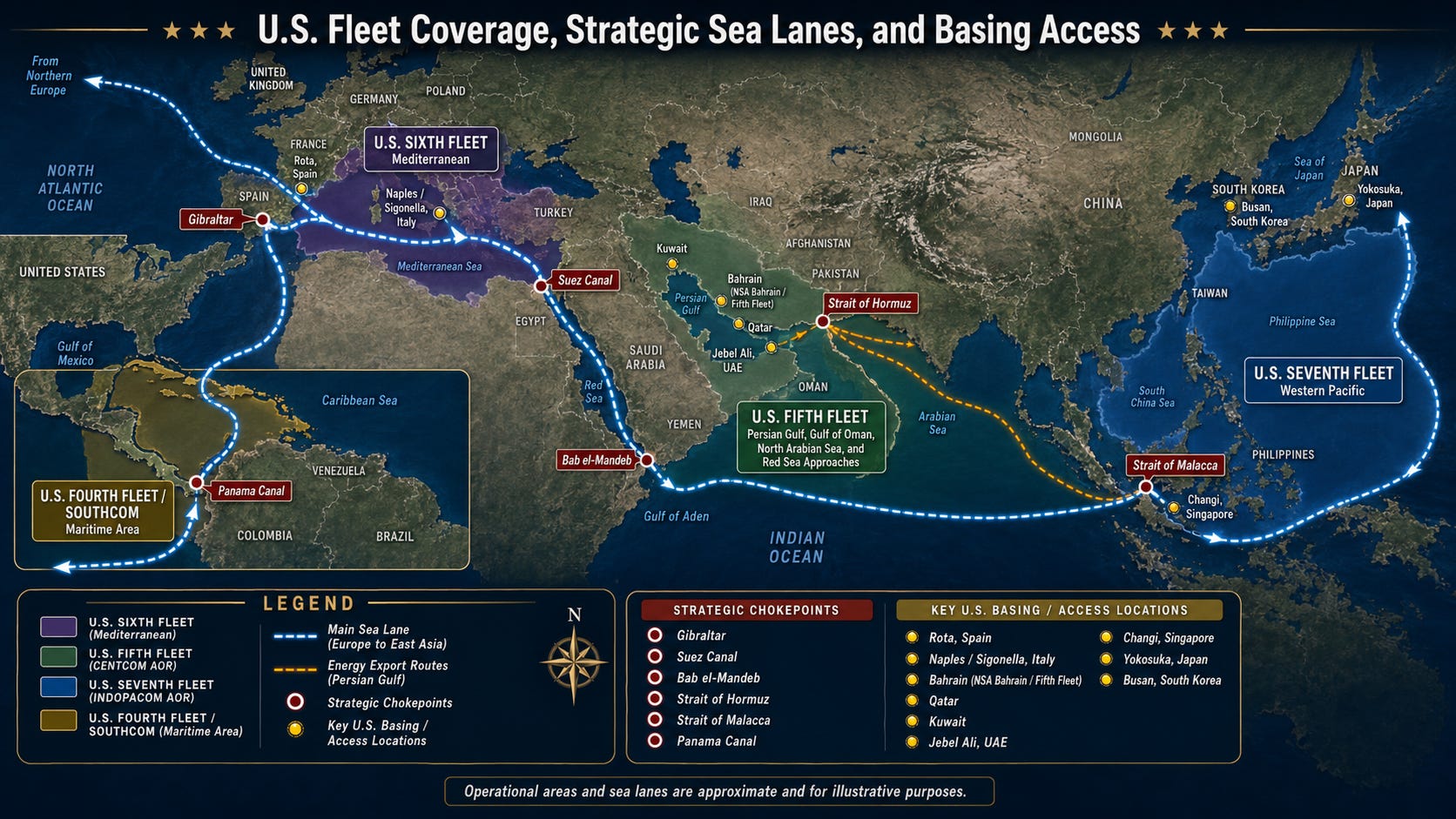
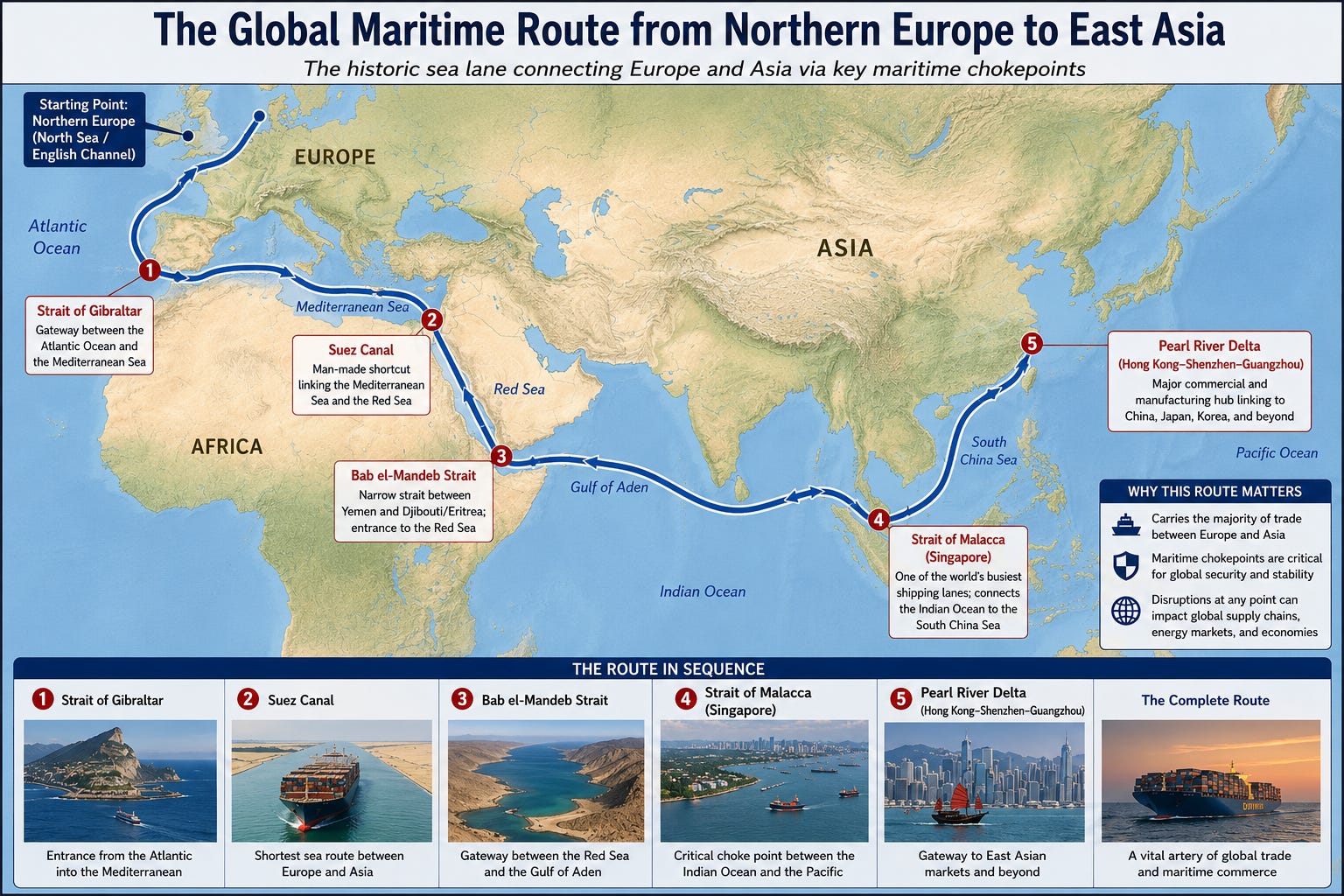
Ships leaving Northern Europe pass through the Strait of Gibraltar and enter the Mediterranean. Many continue through the Suez Canal, descend the Red Sea, pass through Bab el-Mandeb, cross the Indian Ocean, transit the Strait of Malacca near Singapore, and continue toward East Asia.
Energy leaving the Persian Gulf must first pass through the Strait of Hormuz before joining many of those same maritime routes.
Grain and other goods moving from the Black Sea reach the Mediterranean through the Bosporus and the Dardanelles—the Turkish Straits.
Trade between the Atlantic and Pacific is shortened dramatically by the Panama Canal.
Trace these routes slowly, and the map begins to change.
You stop seeing only countries.
You begin to see passages.
Gates.
Straits.
Ports.
Canals.
Places where oceans narrow, trade converges, and the movement of the world becomes vulnerable to a single point of disruption.
5. The Global Mall
Most of us rarely think about the systems beneath ordinary life.
We turn on the lights without thinking about the grid. We walk into a grocery store without thinking about highways, ports, warehouses, refrigeration, insurance, financing, or the thousands of people required to keep the shelves full.
We simply expect the system to work.
The postwar order functioned in much the same way.
Think of it as a global mall.
Shoppers see open stores, stocked shelves, and goods moving freely from one place to another. They do not see the loading docks, maintenance crews, security systems, insurance contracts, delivery schedules, or financial networks operating behind the walls.
Yet those hidden systems make everything else possible.
For much of the past eighty years, the United States has served as the world’s mall manager.
It helped protect the entrances, secure the loading docks, maintain the major corridors, and preserve the conditions under which goods, money, energy, and information could continue moving across borders.
That role has been costly. It has drawn the United States into wars, alliances, commitments, and disputes that many Americans have questioned.
But if the manager withdraws, the mall does not remain unchanged.
Other powers test the doors.
Regional actors seize weak points.
Shipping routes shift.
Insurance costs rise.
Energy prices move.
Supply chains tighten.
And eventually, the consequences reach people who never knew the hidden system was there.
Only when the flow is interrupted does the architecture become visible.
6. Risk Changes Everything
California offers a familiar example.
After repeated wildfires, many homeowners saw insurance premiums rise sharply. In some communities, insurers reduced coverage or withdrew from the market altogether.
6. Risk Changes Everything
California gives us a familiar way to understand how risk works.
After years of destructive wildfires, many homeowners saw their insurance premiums rise sharply. In some communities, insurers stopped writing new policies or withdrew from the market altogether.
The homes themselves had not suddenly changed. What changed was the likelihood that they might be damaged or destroyed.
That is what insurance does. It translates risk into cost.
Global shipping works the same way.
A drone does not have to sink every tanker or close an entire sea lane. It only has to make the journey dangerous enough that insurers, shipping companies, banks, and energy markets begin recalculating.
As the possibility of loss rises, insurance becomes more expensive. Shipping companies look for safer routes. Banks become more cautious about financing vessels and cargoes. Energy traders begin anticipating delays and shortages.
A relatively inexpensive weapon can therefore affect billions of dollars in commerce, not simply because of what it destroys, but because of the uncertainty it creates.
The United States confronted an earlier version of this problem at the beginning of its national life.
Barbary corsairs operating from the coast of North Africa captured merchant ships, seized cargoes, and held sailors for ransom. European powers had long paid tribute to protect their commerce, and the young United States initially did the same.
Thomas Jefferson understood that the problem was larger than the loss of a few ships. If a small regional power could make American trade dangerous enough, it could continue imposing costs on the entire country.
As president, Jefferson sent the young United States Navy into the Mediterranean, helping begin the First Barbary War.
The lesson was already clear: it is not enough to produce goods and find buyers. The routes between them must also remain open.
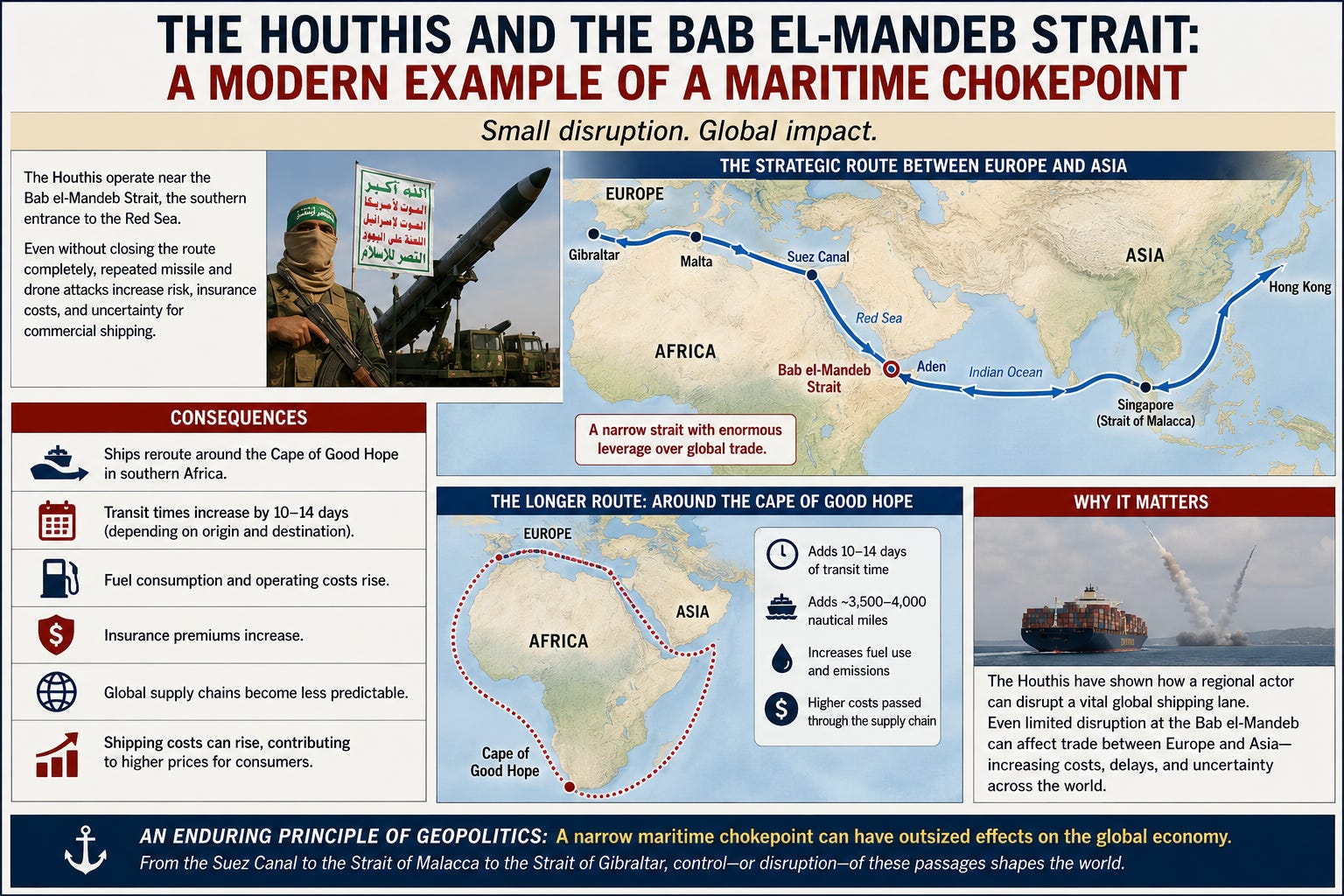
The Houthis demonstrate the same principle today near Bab el-Mandeb, at the southern entrance to the Red Sea.
They do not need to close the passage completely. They only need to make it dangerous enough that ships begin avoiding it.
When vessels reroute around the Cape of Good Hope, voyages grow longer, more fuel is consumed, insurance becomes more expensive, and deliveries are delayed. The weapon itself may be cheap, but the disruption it creates is not.
Like wildfire risk in California, danger at a maritime chokepoint spreads far beyond the place where it begins. The cost moves through insurance companies, banks, shipping firms, energy markets, manufacturers, and retailers until it finally reaches people who may never see the fire, the drone, or the narrow passage where the trouble started.
7. Russia, Ukraine, and the Warm Seas
Russia begins to make more sense when geography comes before ideology.
It is the largest country in the world, with an immense coastline, but much of that coastline lies far from its principal centers of population and industry or opens onto waters shaped by distance, ice, and severe conditions. Reliable access to warmer seas has therefore remained a persistent Russian concern.
The Black Sea provides one of Russia’s most important southern approaches to the Mediterranean and the wider world. But that route narrows before it opens.
Any Russian naval force leaving the Black Sea must pass through the Bosporus, cross the Sea of Marmara, and continue through the Dardanelles before reaching the Mediterranean. Turkey controls both straits.
That brings Crimea, Ukraine, the Black Sea, and Turkey into a single strategic picture.
Crimea gives Russia Sevastopol, the historic base of its Black Sea Fleet, along with greater naval reach and depth within the region. Ukraine occupies much of the Black Sea’s northern coast and lies across the broad land corridor between Russia and Central Europe. Turkey stands at the maritime gate connecting the Black Sea to the Mediterranean.
Seen at high power, the war in Ukraine is a dense field of battles, personalities, weapons, alliances, grievances, and competing historical claims.
Pull back, and the underlying architecture comes into view.
Russia has repeatedly sought strategic depth, territorial buffers, defensible borders, and reliable access to the sea. This does not explain everything about the war, and it does not determine who is right. But it reveals the geography pressing beneath the history.
Crimea is the naval position.
Ukraine is the buffer and the corridor.
Turkey controls the gate.
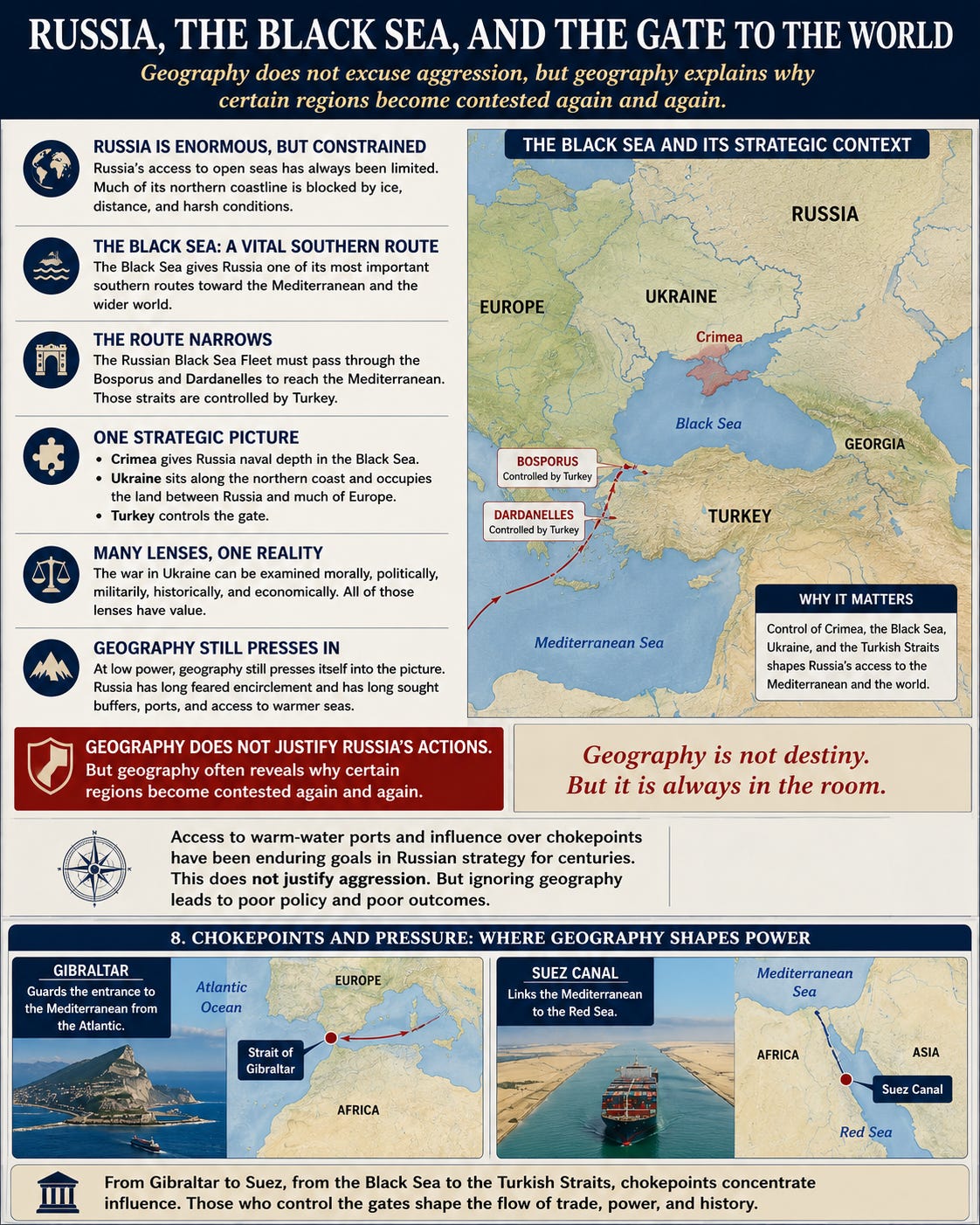
None of this justifies Russia’s actions. Geography does not excuse aggression, but it often explains why certain regions become strategic fault lines—and why they are contested again and again.
8. Chokepoints and Pressure
Once I began looking at the world through this architectural lens, many events and policy choices that had seemed separate began to fall into a common pattern.
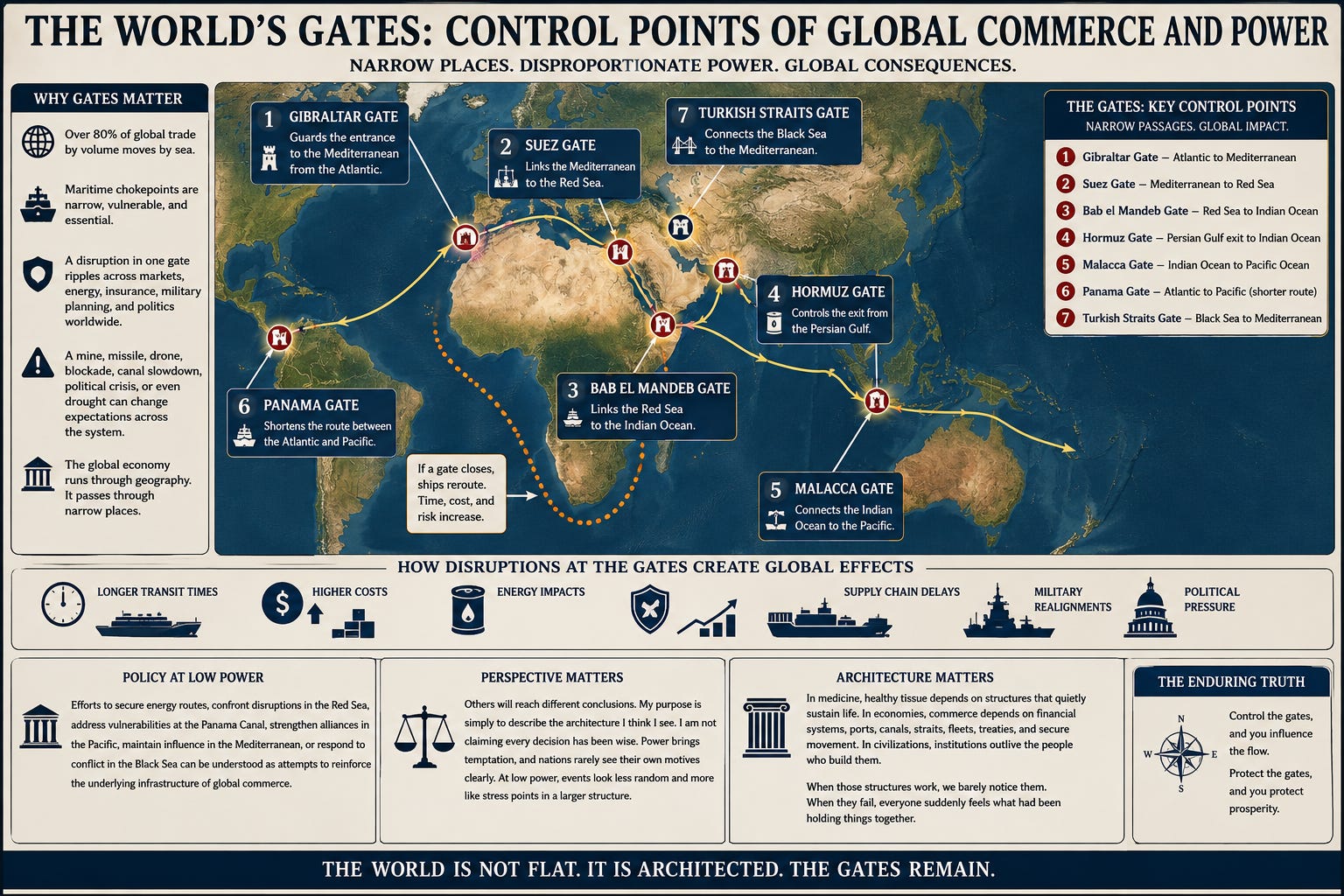
Gibraltar controls the Atlantic entrance to the Mediterranean. From there, the Suez Canal opens the route into the Red Sea, while Bab el-Mandeb controls the passage onward into the Indian Ocean. Farther east, the Strait of Malacca connects the Indian and Pacific Oceans. The Strait of Hormuz governs the flow of energy from the Persian Gulf. The Turkish Straits connect the Black Sea to the Mediterranean, while the Panama Canal dramatically shortens the journey between the Atlantic and Pacific.
These are not simply points on a map. They are pressure points within the global system.
A disruption at any one of them can reshape shipping routes, delay energy supplies, raise insurance premiums, alter military planning, and influence political decisions thousands of miles away.
It does not always require a war or a fleet. A mine, a missile, a drone, a blockade, a grounded ship, political unrest, or even drought reducing canal capacity can change the calculation of risk across the entire network.
The global economy may appear weightless—money moving electronically, orders placed instantly, markets responding in seconds—but the goods themselves still move through geography.
And geography narrows.
9. Policy at Low Power
Viewed through this architectural lens, many contemporary policy choices begin to connect.
Securing energy routes, confronting disruptions in the Red Sea, addressing vulnerabilities around the Panama Canal, strengthening alliances in the Pacific, maintaining influence in the Mediterranean, and responding to conflict in the Black Sea can all be understood as efforts to reinforce the underlying structure of global commerce.
This does not mean that every American decision has been wise. Many clearly have not. Power brings temptation, and nations are rarely honest about all their motives.
My purpose is not to defend every policy, but to describe the architecture I see beneath them.
At high power, the world appears as a succession of crises: Ukraine, Iran, Taiwan, the Houthis, tariffs, oil, shipping, alliances, and war.
At low power, they appear less random.
They become points of strain within a larger structure.
The headlines differ.
The architecture connects them.
10. Architecture Matters
For me, the larger lesson is simple:
Architecture matters.
In medicine, healthy tissue depends upon structures that quietly sustain life.
In commerce, prosperity depends upon financial systems, insurance, ports, canals, straits, fleets, treaties, energy routes, and the secure movement of goods.
In civilizations, institutions often outlive the people who build them.
When these structures are working, we barely notice them.
When they begin to fail, everyone suddenly discovers what had been holding the system together.
Perhaps this is one of the deepest lessons pathology has taught me—and one that has quietly shaped my fifty years in this country.
Begin at low power.
Do not begin with the most inflamed cell.
Do not ignore it, either.
First, understand the architecture.
I came to America during its Bicentennial.
Now, as the nation reaches its 250th birthday, I find myself grateful not only for what America gave me, but for the way these fifty years have taught me to look beneath the surface.
The world is noisy.
The headlines arrive quickly.
Each one demands immediate attention.
But beneath the noise, there is structure.
Begin at low power.
Understand the architecture.
Then zoom in.
My husband, also a physician, believes exactly the same way in regards to looking at and understanding the big picture, or the forest, before focusing on the trees. He explains it differently. He says it’s important to understand anatomy before physiology; intent, design, and purpose before diagnosis and treatment. Your analogy and application to understanding what’s happening in the world is extremely illuminating. Thank you!
So very helpful to get the big picture!