I’ve been thinking about Wormtongue again.

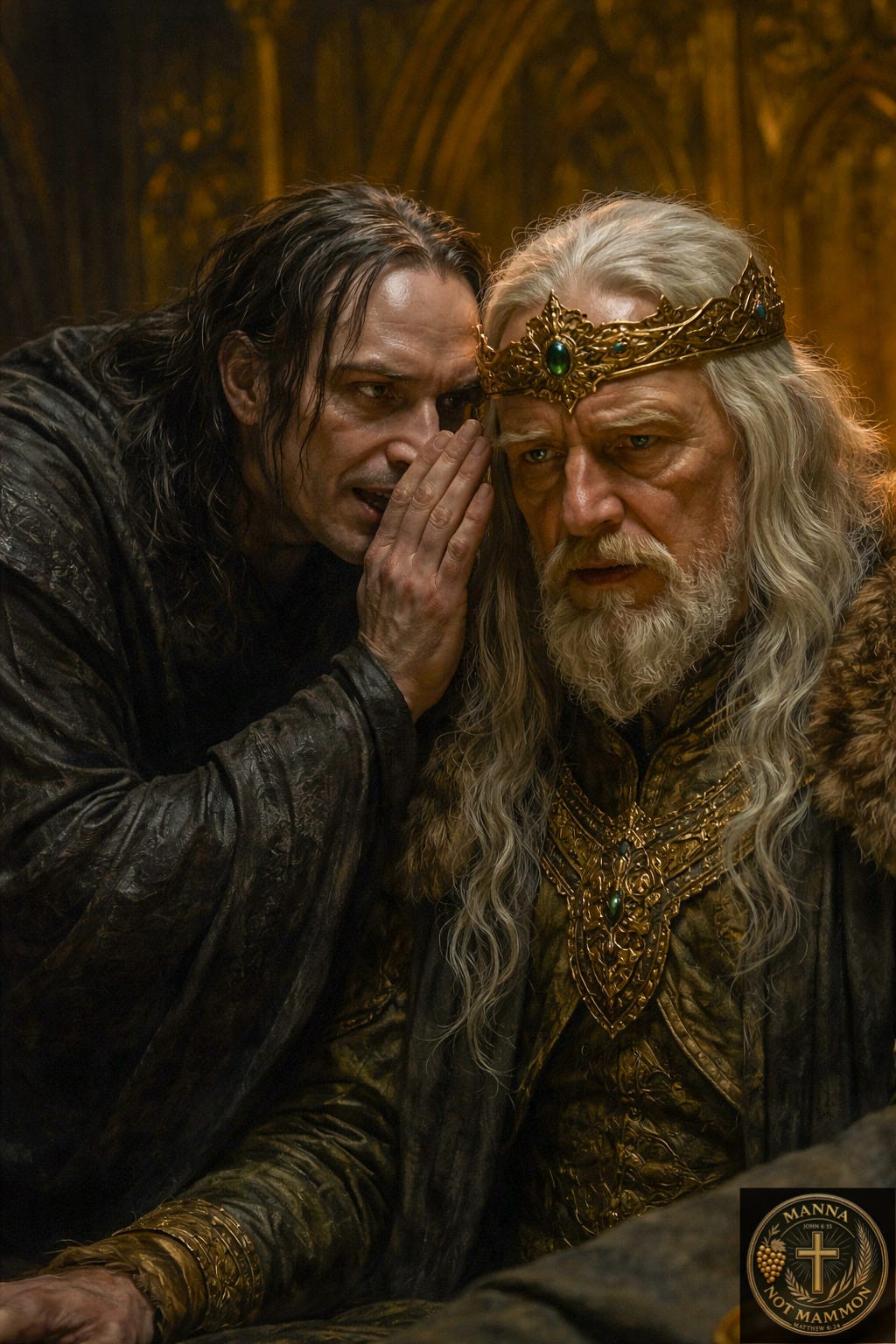
In Tolkien’s The Lord of the Rings, Gríma Wormtongue stands near the throne of King Théoden, speaking into the ear of a ruler who has grown tired and uncertain. Behind Wormtongue stands Saruman, once wise, now bent inward by ambition. Behind Saruman stands Sauron, the darker will spreading outward across Middle earth. Influence moves along that chain, and by the time it reaches the king it sounds almost reasonable.
Nothing dramatic happens at first in the hall of Rohan. The air changes. Words begin carrying different weight. Ordinary frustrations receive new explanations. Loyalty slowly begins to look naïve. Patience starts to feel like weakness. I find it striking that the kingdom weakens long before any army arrives. The shift begins in interpretation. As interpretation changes, emotional posture changes with it. As posture settles into something narrower, decisions begin following that direction. Meaning reorganizes emotion. Emotion reorganizes action. Action reshapes structure.
Reading the book Bad Therapy: Why the Kids Aren’t Growing Up by Abigail Shrier has made me think about how much power counsel actually carries. Counseling shapes interpretation, and interpretation shapes reality. When counsel is wise and disciplined, it strengthens clarity, courage, and responsibility. When it is poorly trained or driven by ideology, it can narrow the field of vision. Normal human conflict can be recast as pathology. Endurance can be reframed as dysfunction. The language itself begins steering the outcome. I’ve watched how quickly a category can harden into identity, and how identity can begin directing decisions that once would have felt unthinkable.
Fear has a powerful organizing effect. When it becomes the primary lens, separation can feel like wisdom. When grievance becomes central, community begins thinning from the inside. Marriage, friendship, companionship, community … each rests on shared meaning. Once the story explaining the bond changes, the bond itself begins moving in that direction.
Paul names something similar in 2 Timothy 4. Near the end of his life he writes that people will gather teachers suited to their own desires, because their ears long to hear what resonates. I’ve always found that image unsettling. Appetite invites explanation. Desire selects the voice. The interpretation that feels most aligned with our interior mood often becomes the one we trust.
Tolkien traces corruption backward to an older root. Saruman bends toward Sauron, and further back still stands the ancient serpent who whispers about identity before anything visibly breaks. The fracture begins in perception. Division follows as a consequence.
Once a certain meaning takes hold, emotional posture follows. Once posture settles, decisions align. A relationship can weaken long before anyone walks away, simply because the story attached to it has shifted.
I suppose the question that stays with me is this.
What kind of counsel is shaping the way we interpret the people we love … and where is that interpretation leading.