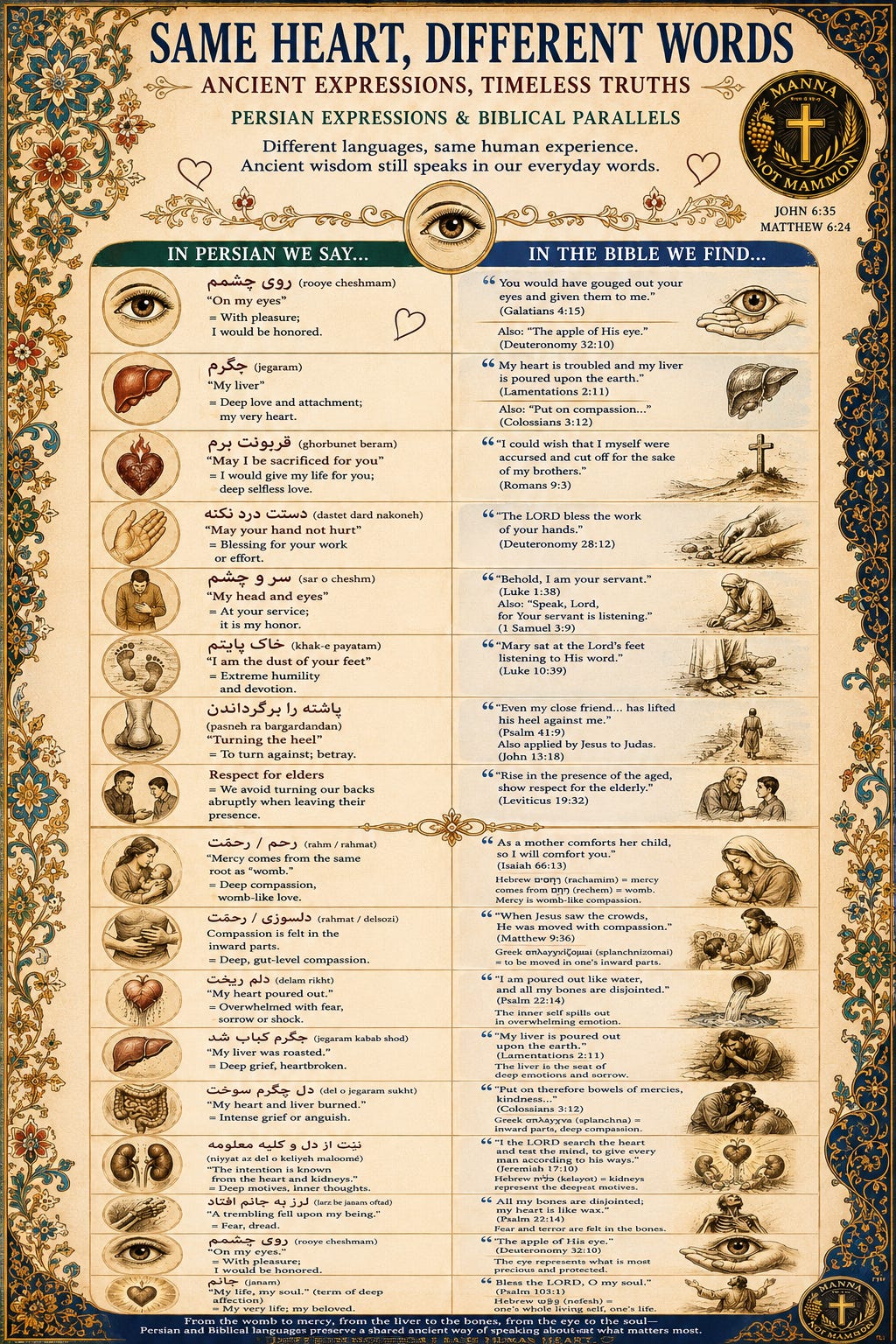
Different Words, Same Human Heart

One of the things that has always fascinated me as a native Farsi speaker is how naturally biblical language feels when I read it.
Many of the expressions that sound strange or poetic in modern English feel completely ordinary in Persian. We still speak about the liver, the kidneys, the bones, the eyes, and the heart in ways that mirror the language of Scripture. We speak of a heart pouring out, a liver burning with grief, trembling in our bones, and holding someone “on our eyes” as a sign of honor and affection.
This is more than coincidence.
For centuries, Aramaic served as the common language across much of the Persian Empire. It was the language spoken by ordinary people throughout the Near East and the language Jesus Himself likely spoke in daily life. Hebrew, Aramaic, Persian, and later Greek existed in constant conversation with one another. Ideas, metaphors, and ways of expressing emotion traveled across cultures and generations.
Whether Persian influenced Aramaic, Aramaic influenced Persian, or both inherited older Near Eastern patterns of thought is difficult to determine. The relationship is less a matter of deciding which came first and more a matter of recognizing that these cultures shared a common understanding of the human person.
Modern Western languages often place emotions primarily in the mind or the heart. Ancient peoples spoke differently. Compassion came from the womb. Deep sorrow was felt in the liver. Motives resided in the kidneys. Fear shook the bones. Love and mercy were experienced in the body’s deepest places.
The Greek New Testament preserves the same worldview. When the Gospels say that Jesus was moved with compassion, the word used is splanchna—the inward organs, the deepest parts of a person. Compassion was not an idea. It was something felt viscerally.
That is why so many biblical expressions feel immediately familiar to Persian speakers. The emotional geography is the same. The body becomes a map of the soul.
Perhaps that is one reason these ancient texts continue to speak so powerfully across cultures. Beneath different languages and different centuries, the human heart remains remarkably unchanged.
From the womb to mercy, from the liver to grief, from the eye to honor, from the bones to fear, these ancient expressions remind us that human beings have always searched for words to describe the deepest movements of the soul.
Different words. Same human heart.