Advent Week 3: When Joy Finds Its Voice
The shout, the whisper, and the God who holds them both

“The desert shall rejoice and blossom…. it shall exult with joy and singing.” — Isaiah 35:1–2
“My spirit rejoices in God my Savior.” — Luke 1:47
“Rejoice in the Lord always; again I will say, rejoice.” — Philippians 4:4
Joy is the theme of Advent’s third Sunday. But Scripture refuses to give us only one kind of joy.
It gives us a spectrum—a joy that dances in the open air and a joy that sits quietly in the heart; a joy that shouts and a joy that simply holds on.
When I was a toddler, my aunts would lean close, smiling, and gently brush their fingers beneath my chin or along my cheek, repeating the same soft, playful sound: gili-gili-gili. It wasn’t tickling meant to provoke laughter. It was tender, rhythmic, almost musical — a way of coaxing joy forward, of lifting a quiet or uncertain heart. It always felt safe. A word shaped by affection.
Later, as I grew older, I heard a different expression of that same joy at weddings across the Middle East, especially within Persian and Mizrahi Jewish communities. A bright, rolling trill — “li-li-li-li-li!” — would rise from the women when the heart became too full to remain silent. The sound moved communally through the room, warm and enveloping, carrying celebration not as spectacle but as shared presence. It filled the space with belonging — joy in motion, joy shared.

While studying Scripture, I came across the Hebrew word for joy: gîyl — a verb that carries the sense of exultation, of turning or spinning with gladness, of joy that moves rather than merely rests. And with that discovery, something quietly fell into place.
The sounds that had shaped my earliest memories — gili-gili, li-li-li-li — were not translations of that word, yet they echoed it in both rhythm and spirit. Across cultures and generations, joy was not only named or proclaimed; it was drawn out, gently and relationally, as something meant to be awakened in another.
What I had known as a child through touch and sound, what I later heard carried through wedding celebrations, and what Scripture names as holy movement all began to converge. A tenderness offered to a quiet child, a communal voice rising in celebration, and a biblical vision of joy as motion rather than possession — distinct expressions, yet deeply aligned.
Joy, Scripture reminds us, has never been uniform. Some hearts rejoice through movement and sound, others carry joy quietly, like a steady flame. Both are gifts of the same Spirit, both belong in Advent, and both have their place within the family God is shaping.
1. Joy in Advent: A People Learning to Receive
Joy in Scripture is not a command to “feel happy.” It is a sign that God is near, that something long promised has entered the world.
Isaiah 35 pictures joy bursting out of places that had been barren:
“The desert shall rejoice…
the burning sand shall become a pool.” — Isaiah 35:1,7
Isaiah is describing joy as the outward sign of God’s restoring presence. The desert is not simply changing scenery; it is creation responding to the return of its Creator. Barren places become fruitful, dryness gives way to life, and what once could not sustain anyone becomes a place of refreshment. Joy, in this vision, is not emotional optimism but evidence that God has come to heal what was broken and to make the world habitable again.

After the rains in Anza-Borrego, I watched the desert bloom—small yellow flowers breaking through sand that had seemed barren only days before. Up close, there was more life than I expected: caterpillars moving along fresh stems, ladybugs clinging to petals, quiet signs that the land was not only flowering but awakening. Seeing it with my own eyes, Isaiah’s words felt less like metaphor and more like recognition: joy as creation’s response to restoration quietly received.
Mary gives us another picture—quiet, interior, contemplative:
“My spirit rejoices in God my Savior.” — Luke 1:47
“Mary treasured up all these things and pondered them in her heart.” — Luke 2:19
Mary held the events as something precious while actively bringing them together, turning them over, letting meaning emerge slowly.
Paul gives us yet another:
“Rejoice in the Lord always… the Lord is near.” — Philippians 4:4–5
Paul writes those words from prison, not from comfort, and that context matters. When he urges the Church to rejoice always, he is not asking them to manufacture happiness or ignore what is hard, but to let their joy be anchored somewhere deeper than circumstance. That is why he immediately adds, “the Lord is near.” Joy, for Paul, flows from nearness—Christ present with them now and Christ drawing history toward its restoration. It is a joy rooted in relationship rather than mood, steadied by the assurance that God is both attentive and at work, even when life feels uncertain.
This joy encompasses the loud-hearted charismatic, the quiet Anglican contemplative, the Catholic who prays with beads, the Presbyterian who sings psalms, and the Orthodox Christian lifting incense—all of them are expressing real joy in their own way.
2. Joy That Moves — The Shout
Some passages in Scripture erupt with joy so physically that the heart can’t help but move. These are the passages for those who feel God in their bones, who sing loudly, who raise their hands, who dance, who celebrate with their whole selves.
David Dancing Before the Ark
“David danced before the Lord with all his might.” — 2 Samuel 6:14
David’s joy is unrestrained. His body participates in worship.
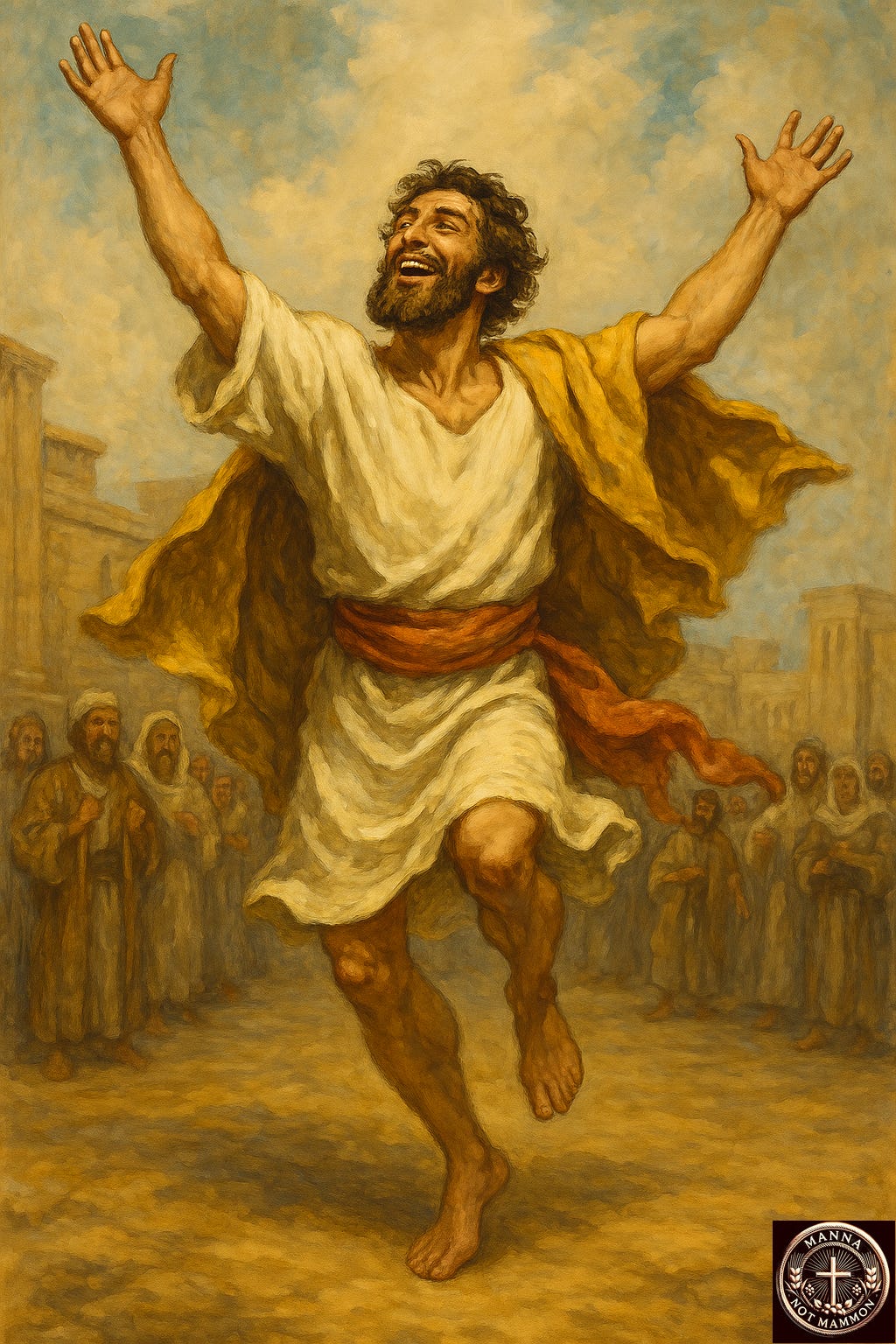
Joy here is not calm or quiet. It is overflow.
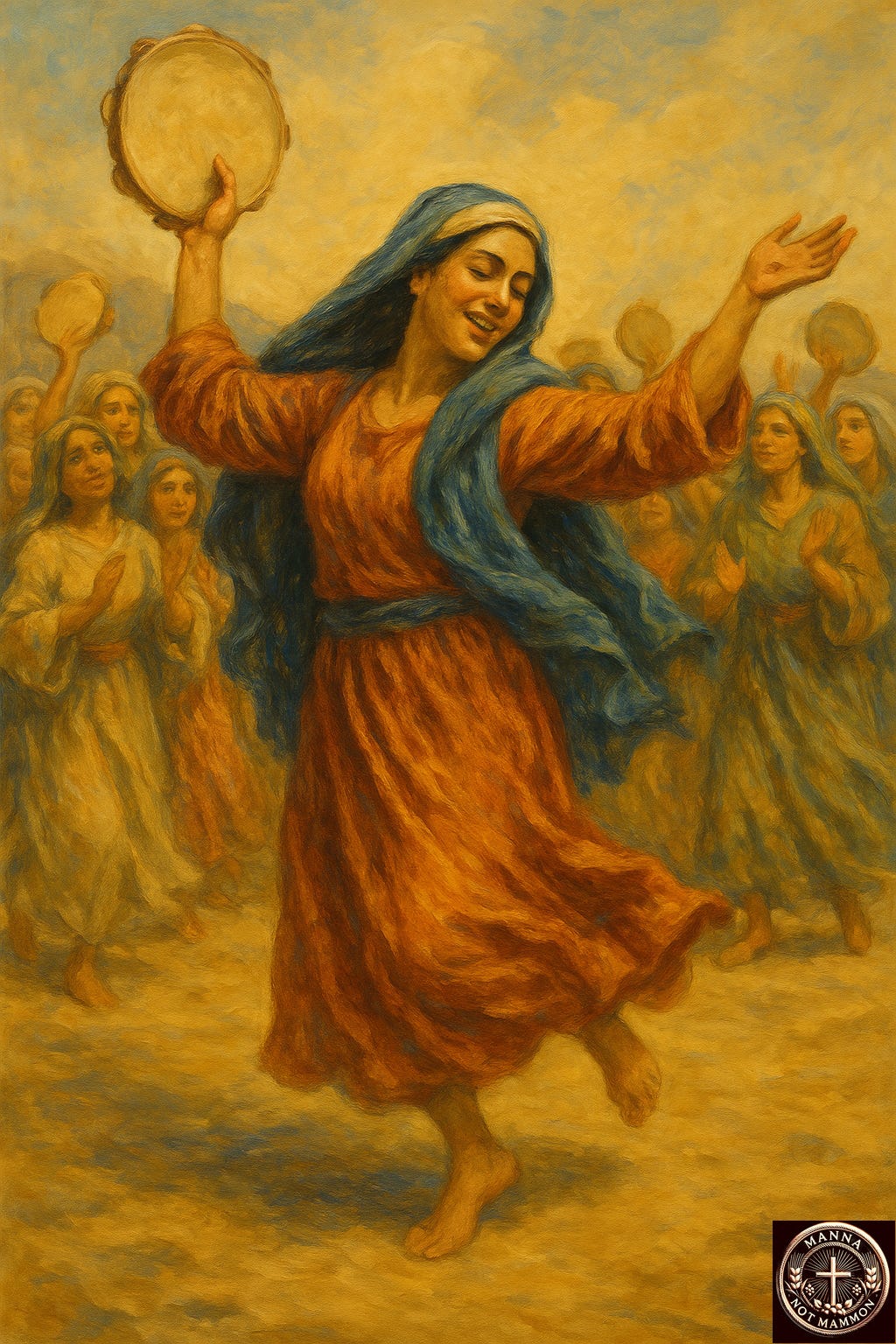
Miriam and the Women After the Red Sea
“Miriam took a tambourine… and all the women went out after her with tambourines and dancing.” — Exodus 15:20–21
Their joy is a response to deliverance. The kind of joy that insists on being embodied.
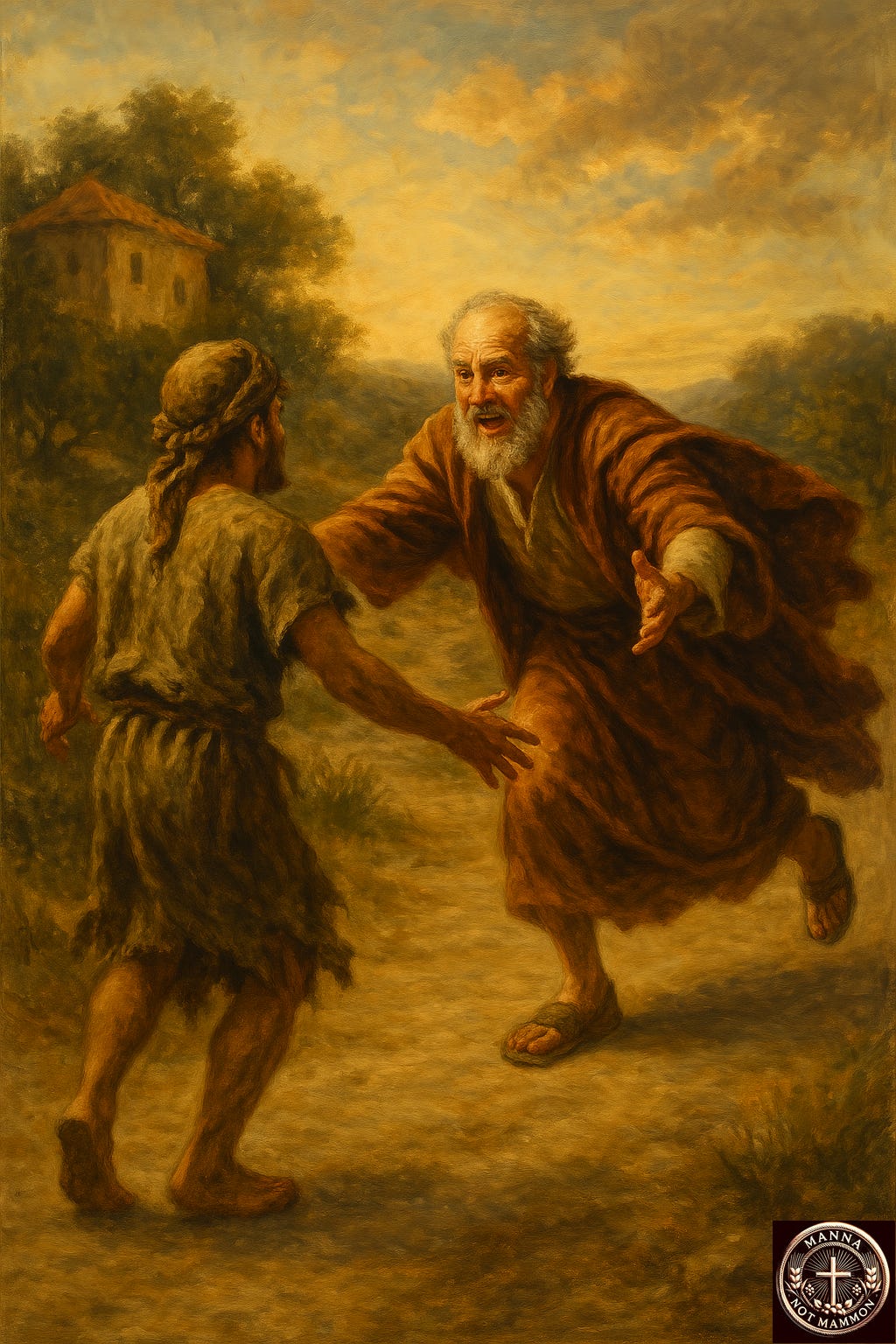
The Prodigal Son’s Return
“Bring the fattened calf… let us feast and celebrate!” — Luke 15:23–24
Jesus is describing the moment when restoration is no longer theoretical but embodied. The father does not interrogate the son, measure his remorse, or wait for proof of reform. Instead, he interrupts the return with action—clothing him, feeding him, gathering others—because relationship has been restored. The feast is not a reward for good behavior but a public declaration that what was lost has been recovered and life has resumed. Joy here is immediate, relational, and communal, spilling outward as celebration because love has been restored to its rightful place.
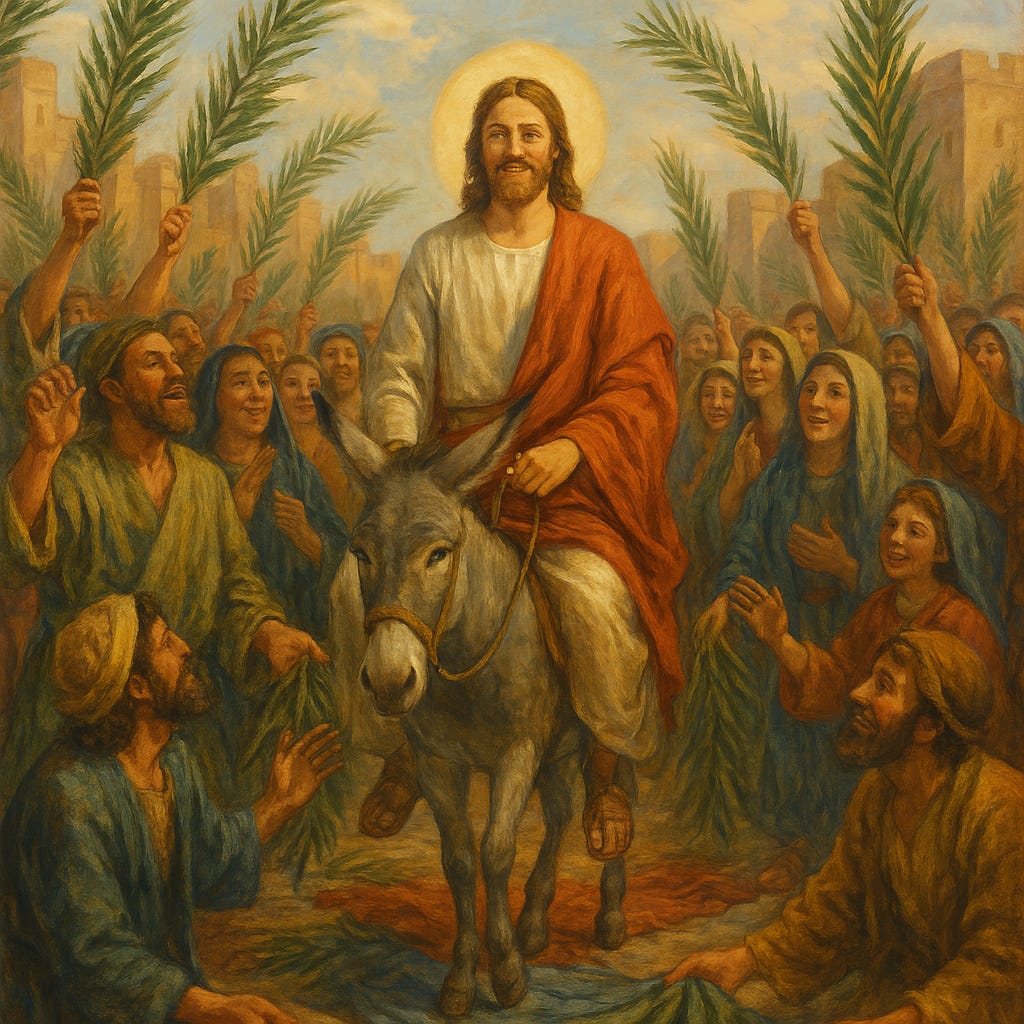
The Crowds at Jesus’ Triumphal Entry
“They praised God in loud voices for all the miracles they had seen.” — Luke 19:37
This moment comes as Jesus approaches Jerusalem, descending from the Mount of Olives, when the long tension of expectation finally breaks into recognition. The crowd is not praising God in abstraction; they are responding to what they have already witnessed—healings, restorations, lives put back together before their eyes. Their praise rises “in loud voices” because gratitude and awe can no longer remain contained. Joy here is not rehearsed or strategic; it is the spontaneous response of people who sense that God’s saving work is drawing near, even if they do not yet understand the cost of what is coming next.
3. Joy That Rests — The Silence
But Scripture gives another side.
A quieter one.
A joy that endures even when no outward celebration is possible.
This is the joy of those who sit at hospital bedsides, who carry burdens, who pray alone, who wait longer than they ever hoped they would, who love God without spectacle.
Mary Pondering
“Mary treasured up all these things and pondered them in her heart.” — Luke 2:19
Luke is describing a posture of receptive attentiveness rather than outward response. Mary has just heard extraordinary words about her child—spoken by shepherds, echoed by angels—and instead of reacting with explanation or display, she gathers these moments inwardly. To “treasure” them is to hold them as something precious and unresolved; to “ponder” them is to turn them over slowly, allowing meaning to emerge in its own time. Joy here is quiet and patient, marked not by certainty but by trust, as Mary receives what God is doing without needing to grasp or control it.

Jesus, For the Joy Set Before Him, Endured the Cross
“For the joy set before him he endured the cross.” — Hebrews 12:2
This is the fiercest joy in Scripture. The cross is not minimized or spiritualized away; it is endured. What sustains Jesus is the joy “set before him”—the joy of love fulfilled, of reconciliation accomplished, of humanity restored to God. This joy is not the feeling of the moment but the purpose beyond it, a joy rooted in self-giving rather than relief. Here, joy becomes strength: the ability to remain faithful to love even when the path leads through pain.
Paul’s Joy in Suffering
“In all our troubles my joy knows no bounds.” — 2 Corinthians 7:4
Paul is describing a joy that coexists with real hardship rather than replacing it. He is not denying trouble—he names it plainly—but testifying that joy has grown within it. In this context, Paul is speaking about reconciliation restored, relationships healed, and God’s faithfulness revealed through suffering. His joy “knows no bounds” not because circumstances are easy, but because love has proven resilient and God’s work has not been thwarted. Joy here is expansive precisely because it has passed through difficulty and discovered that grace holds even there.
Habakkuk’s Joy Without Visible Blessing
“Though the fig tree does not bud… yet I will rejoice in the Lord.” — Habakkuk 3:17–18
Habakkuk is naming a joy that remains even when every visible sign of blessing has failed. The fig tree, the vine, the fields, the flock—these were not luxuries but the foundations of daily life, provision, and security. By saying he will rejoice anyway, Habakkuk is not pretending loss does not hurt; he is choosing trust when there is nothing left to lean on except God Himself. Joy here is an act of allegiance, a refusal to let absence and scarcity define reality more than God’s faithfulness.
Paul and Silas embody the same posture centuries later when they sing hymns in prison after being beaten and chained. Their joy does not come from freedom or relief, but from communion—God present with them in the dark, unguarded by circumstance. In both cases, joy is not a reaction to improvement but a declaration of trust: when everything external collapses, God remains worthy of praise, and that conviction becomes a source of strength that cannot be taken away.
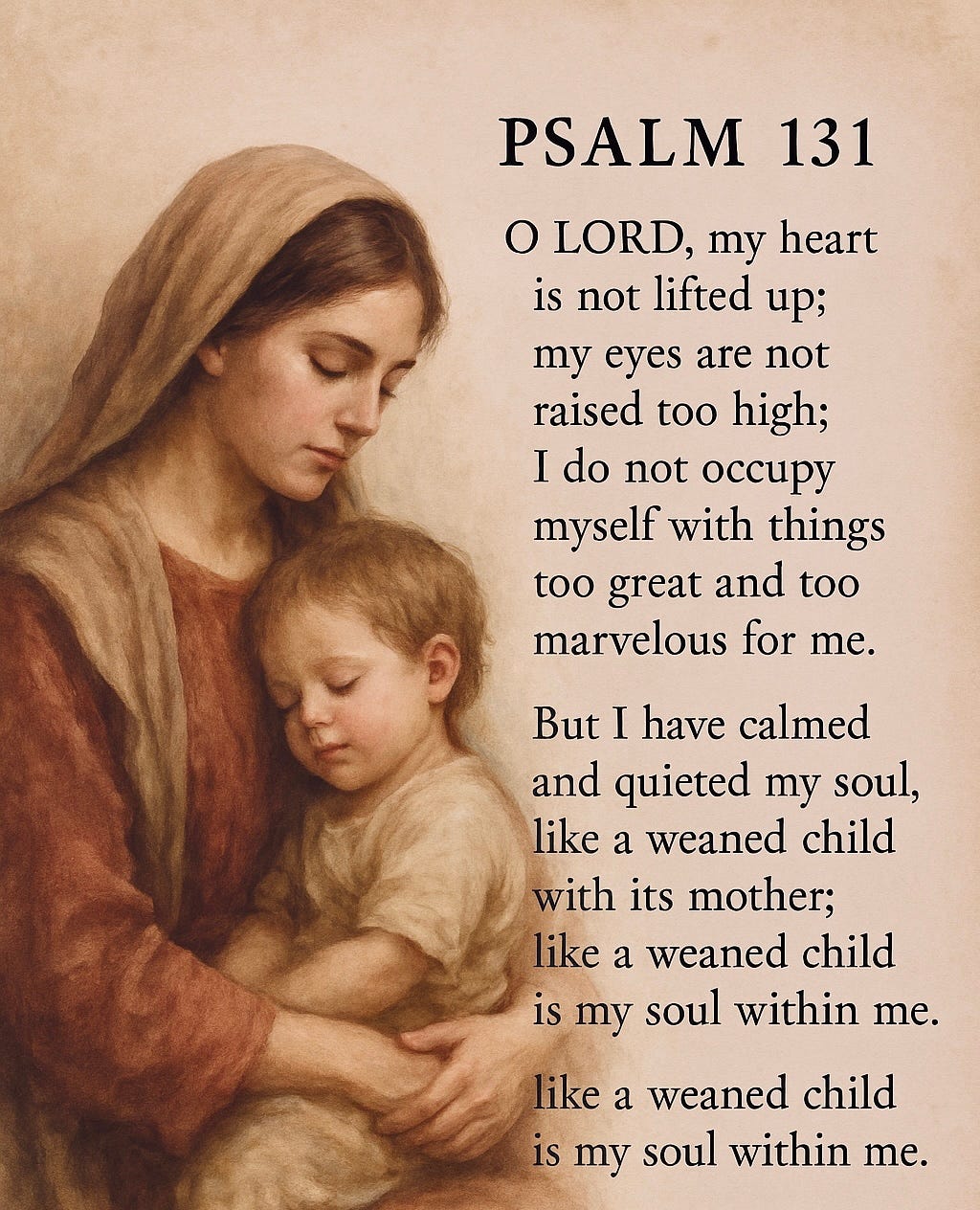
Psalm 131 speaks of joy as rested trust, not excitement or achievement. The psalmist describes a heart that has been quieted and calmed, no longer striving for what is too great or too complex to control, but choosing humility and dependence instead. The image of a weaned child with its mother is especially telling: not a child crying for milk, but one content simply to be held. Joy here is not exuberance or triumph; it is peace born of surrender, the deep satisfaction of belonging and safety. It is the joy of no longer needing to grasp, because one has learned to rest in God’s care.
Advent’s readings refuse to rush joy. James tells a weary Church to be patient, to strengthen their hearts like a farmer waiting for precious fruit, because the coming of the Lord is near. And when John the Baptist, imprisoned and unsure, sends his question to Jesus — Are you the one, or should we look for another? — Jesus answers not with argument but with signs of restoration: the blind see, the lame walk, the poor hear good news. Joy here is not spectacle. It is recognition. Trusting that God is at work even when deliverance unfolds more quietly than expected.
4. The Family of God Needs Both Kinds of Joy
One of the tragedies of the modern Church is how easily we divide along personality lines:
“They’re too emotional.”
“They’re too quiet.”
“They’re too expressive.”
“They don’t feel enough.”
But joy has never been a uniform experience.
Advent 3 reminds us:
Joy can be
a shout
whisper
dancing
pondering
celebration
endurance
God is not threatened by any of it. He receives all of it as worship.
The charismatic does not need to become silent to please God.
The contemplative does not need to become exuberant to prove they have joy.
The Body of Christ requires both.
Just as the Hebrew and Persian words—giyl and gili—capture both the spinning leap and the gentle delight, the Church must hold the whole spectrum.
In fact, it is together that we more fully reflect the joy of the Lord.
5. How Joy Prepares Us for Christ
Advent joy is not escapism but preparation. Isaiah dares to look beyond the present moment and speak of a future in which joy and gladness are no longer fleeting experiences but enduring companions, when sorrow and sighing finally loosen their grip and give way to restoration:
“They shall obtain joy and gladness, and sorrow and sighing shall flee away.”
— Isaiah 35:10
Mary shows us that this kind of joy can anchor the soul, held quietly in trust before anything is resolved or explained. Paul shows that joy can strengthen the weary, sustained not by improved circumstances but by the assurance that the Lord is near. Jesus shows that joy can endure even when the road leads through suffering, carried by love set on what will be made whole. Taken together, these witnesses reveal Advent’s deeper truth: joy does not wait for life to fix itself. It flows from the God who stepped into our circumstances and remains with us within them. This is Advent’s secret—not joy as reaction or performance, but joy as presence: Emmanuel, God with us.
6. Practicing Joy This Week
You may be in a season where joy spills out of you. Or you may be in a season where joy barely flickers.
Both are OK , biblical, and welcome in the family of God.
A few questions for reflection:
Where is joy rising in me right now—through expression or through endurance?
Do I give myself permission to rejoice the way God wired me?
Can I celebrate someone else’s expression of joy, even if it looks different from mine?
What kind of joy is the Spirit cultivating in me this Advent?
Let joy rise where it will, root where it must, and take the shape your season requires.
Because Advent joy is not about noise level.
It is about presence—the presence of the One who has come, who is coming, and who will come again.
You can also listen to this reflection as a companion podcast.