Advent Week 2: When Light Begins the World Again
A meditation on illumination, vocation, and restored radiance

Before Scripture speaks of humanity, covenant, or redemption, it shows us a pattern in creation itself:
chaos → presence → illumination → order → beauty
Here is how the text unfolds:
“In the beginning God created the heavens and the earth.
Now the earth was formless and void,
and darkness was over the face of the deep.
And the Spirit of God was hovering over the waters.
And God said, ‘Let there be light,’ and there was light.
And God saw that the light was good,
and God separated the light from the darkness.”
— Genesis 1:1–4
Creation does not begin with vivid landscapes or living creatures.
It begins with formlessness, emptiness, and darkness…
a world unable yet to sustain life or reveal beauty.
Then the Spirit hovers and God speaks.
“Let there be light.”
Before plants grow, before oceans settle, before time is measured, light is called into the void.
Light is the condition for everything else. It is what allows order, separation, flourishing, and life to begin.
When I think of light, I instinctively picture what my eyes can register brightness, color, the way morning pours through a window. Most of us do the same. We equate light with visibility.
But the light of Genesis is far more expansive than anything the human eye detects.
What we call “light” is only a narrow slice of a much larger reality …. a reality that fills the universe with the energy required for order and life.
This is where the physical world becomes a teacher.
1. The Narrow Window of Light
The electromagnetic spectrum spans an enormous range…from radio waves longer than buildings to gamma rays smaller than atoms. If it were stretched across a football field of 100 meters (about 10,000 centimeters), the portion the human eye can detect would occupy one centimeter near the center…. a mere sliver.
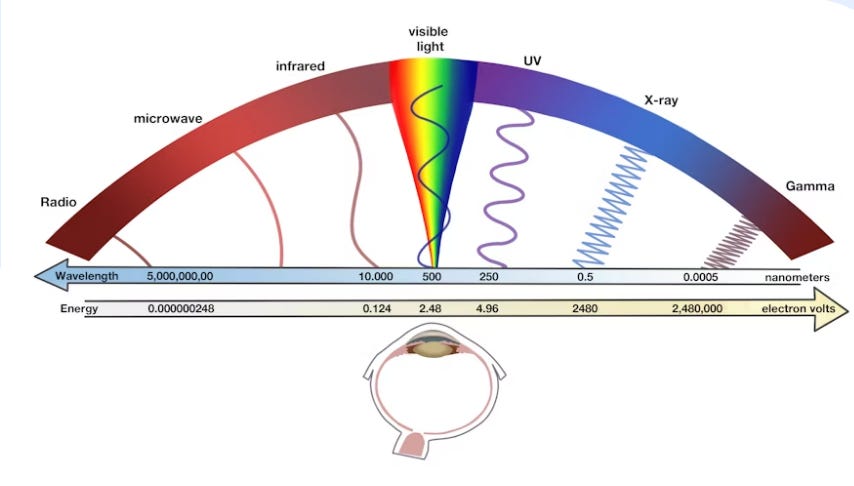
That single centimeter corresponds to wavelengths between 400 and 700 nanometers. A nanometer is one billionth of a meter; a hundred thousand stack inside a millimeter.
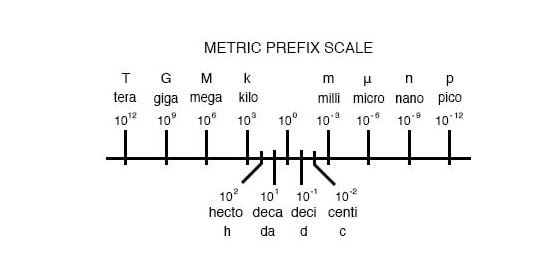
Through that tiny window comes everything the human eye calls “light.” Yet the universe runs on energies far beyond that sliver.
Physical life depends on the whole spectrum, not just what we see.
2. Light as the First Gift of Life
Genesis begins with a world that is formless, empty, and dark, yet waiting. The Spirit hovers, and the first movement of creation is not structure or matter but light.
This light is more than radiance. It is the power that brings separation out of confusion, establishes rhythm, warms the earth, drives photosynthesis, and allows chemistry to gather itself into life. Light is what makes the world capable of relationship and beauty. It is the first condition that allows anything to grow.
Scripture shows that something similar is true of us. There is the light that shapes the natural world, and there is an inner illumination that shapes the human heart. Without it, the inner world loses clarity and purpose.
Confusion settles
Desire drifts
When God speaks light, it is not only the cosmos that awakens. Something in us is meant to awaken too. The disordered chaos in our lives can move to flourishing order.
Just as the first light in Genesis revealed a world already held in the Spirit’s care, there is a kind of illumination that reveals what is held in us. It does not arrive through effort or intensity. It comes through openness, the willingness to let something be seen. And openness requires clearing.
This is where John the Baptist enters the story. His call to repentance is not an accusation but preparation.
It is the act of making space so that the light of Christ can reach what has remained shadowed for too long.
The image that comes to mind for me comes from electron microscopy. A structure becomes visible only when the excess is removed and the section is made thin enough for the beam to pass through. Without that preparation, nothing is revealed. With it, everything hidden becomes clear.
3. Electron Microscopy as a Parable of Illumination
A light microscope can only take us so far. Its resolution is limited by the wavelengths of visible light, which means the deepest structures of the cell — the ultrastructure — remain hidden. To see that inner world, we turn to electrons. Because they behave like waves with far shorter wavelengths, they can reveal membranes, organelles, and the fine scaffolding that holds the cell together.
But electrons cannot pass through just any piece of tissue. The specimen must be cut so thin that it almost defies physical handling. If the section is even slightly too thick, the electron beam scatters and nothing comes into focus.
Preparing material thin enough for electrons to pass through became a central part of my work after college. The tissue was fixed, embedded in resin, trimmed, and then brought to the diamond knife. With a steady advance of the block, the knife released sections only 60–90 nanometers thick — roughly a hundred times thinner than a red blood cell.
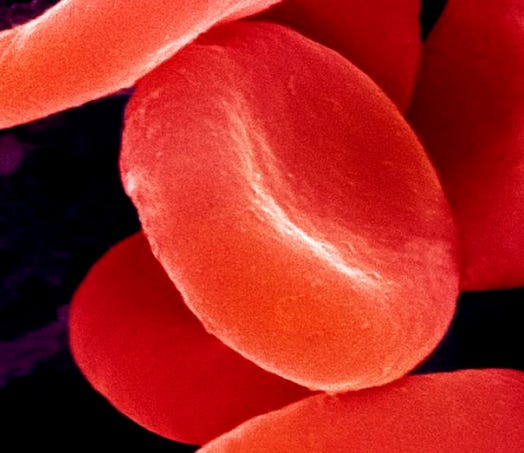
They have almost no physical substance, yet they must remain intact long enough for illumination to move through them.
Each section floated gently onto the water meniscus, and this is where color became the microscopist’s guide.
A reddish tone meant the section was too thick.
A bluish tint meant it was too thin.
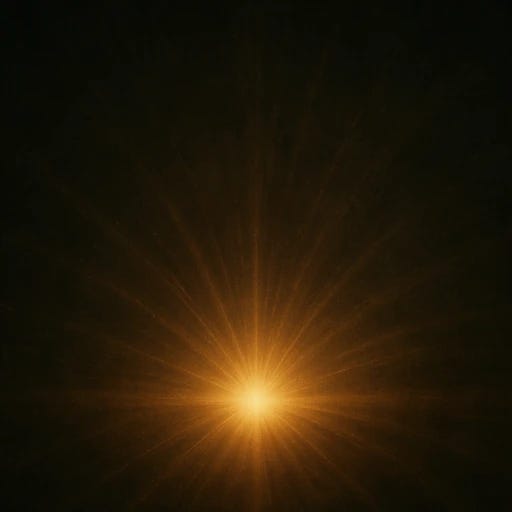
But when the thickness was just right …around 70 nanometers….. the section glowed with a soft, unmistakable gold.
That gold is not a dye or pigment. It appears because light interacts with a film this thin in a special way: part of the reflection comes from the surface of the section, part from the water beneath.
Certain wavelengths cancel each other, others remain, and the surviving color is gold. The same physics colors soap bubbles and oil films, though here the film is thousands of times thinner and its purpose is not aesthetic — it is diagnostic. Gold means the electrons will pass cleanly and the hidden interior of the cell will appear.
Years at the diamond knife taught me something I did not recognize as theological until much later: my job was never to create structure. It was simply to prepare the conditions in which illumination could reveal what had already been there.
Only later, when I encountered the Gospel of John’s language of light, did I realize how deeply that experience had shaped me. Illumination …… in the laboratory or the soul ……. does not invent what is true. It unveils what has been obscured. Truth becomes visible when obstruction is thinned away.

4. The Second Beginning …….John’s Gospel and the Light of Truth
If Genesis describes the birth of physical life, John describes the birth of spiritual life:
“In the beginning was the Word… In Him was life, and the life was the light of men.
The light shines in the darkness, and the darkness has not overcome it.” John 1:1,4–5
This is not sunlight. It is truth, identity, meaning, and the restoration of the image of God.
John the Baptist appears early in this narrative:
“He was not the light, but came to testify about the light.” John 1:8
His message is repentance…..not moral heroics, but preparation.
He thins the soul so illumination can pass through.
Physical light makes the world flourish.
Spiritual light makes the human person become who they were made to be.
5. The Nine Stones …. Ezekiel 28 and the Lost Vocation of Reflection
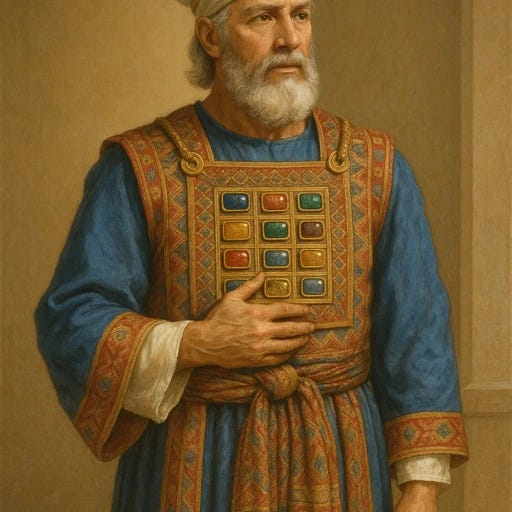
Ezekiel 28 describes a being of extraordinary privilege—“the anointed guardian cherub”—whose role was to stand in the very presence of God. His vestments were set with nine precious stones, echoing (and predating) the twelve stones of Israel’s high priest:
1. Sardius — Deep red to reddish-orange
2. Topaz (pitdah) — Yellow-green to golden-green
3. Diamond (yahalom) — Clear, icy white, or pale reflective
4. Beryl — Sea-green, blue-green, or pale aqua
5. Onyx — Black, banded black-white, or dark layered
6. Jasper — Brick-red, earthy red, or mottled red-brown
7. Sapphire (sappir) (lapis lazuli)— Deep ultramarine blue
8. Emerald (bareqet) — Flashing green, vivid bright green
9. Carbuncle — Garnet-red, glowing red, ember-red
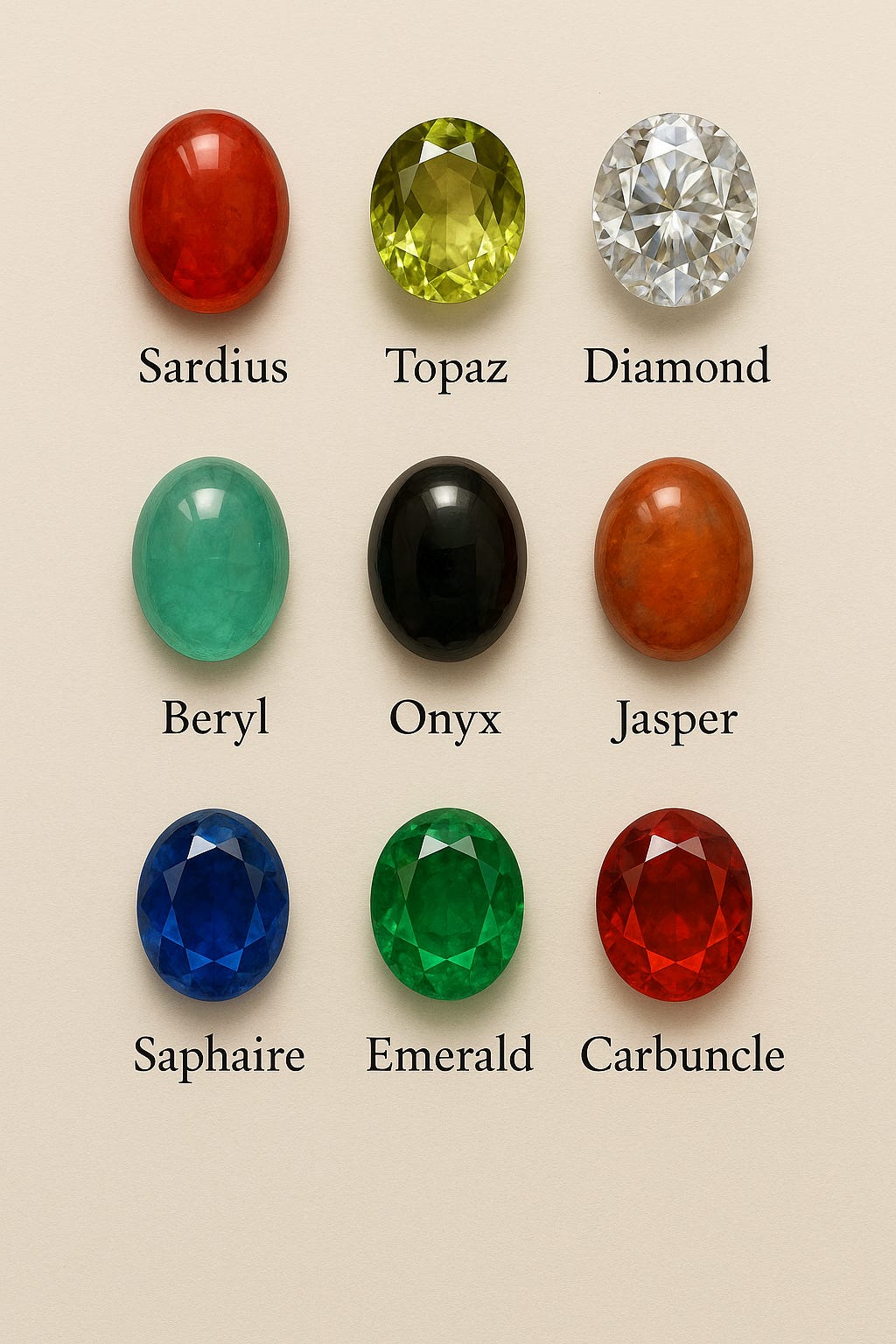
These stones were not ornamental but signified representation and reflection.
Just as the high priest later carried Israel’s tribes upon his breastplate, the guardian cherub bore these stones as part of a vocation rooted in transparency before God. His task was not to shine with his own brightness, but to receive and return the radiance of the One who created him. Everything about the imagery points to a being whose glory was borrowed, whose brilliance depended entirely on the Light he served.
Ezekiel adds an arresting detail:
“The workmanship of your timbrels and pipes was prepared in you on the day you were created.” Ezekiel 28:13
This guardian was not only clothed with reflective beauty but woven with musical design—a creature whose very being was meant to resonate with praise. Reflection and resonance: visual glory and sound united in a vocation of worship.
Yet the turning point in the passage is devastating in its simplicity:
“You were blameless in your ways from the day you were created,
till unrighteousness was found in you.” Ezekiel 28:15
The text does not describe an external temptation but a transition inward.
A being designed to transmit glory outward began to turn inward, to contemplate his own brilliance apart from the One who supplied it. The reflective surface thickened. The resonant heart tightened. The posture that once stood open before God became curved toward the self.
Ezekiel names the result:
corrupted wisdom,
violence,
self-exaltation,
and ultimately a fall from the presence he was meant to reflect.
The nine stones become symbols of a tragically lost vocation..a vocation that reappears, in restored form, in the high priest of Israel and reaches its fulfillment in the true High Priest, Jesus Christ, who needs no borrowed stones because He is the Light Himself.
6. The Grasping Instinct ….Isaiah 14
Isaiah records the interior posture of the fallen being:
“I will ascend…”
“I will raise my throne…”
“I will sit above…”
“I will ascend above…”
“I will make myself like the Most High.” Isaiah 14:13–14
The five "I wills’” of grasping
This Grasping is the beginning of mammon.
It is the insistence on self-generated meaning, power, or identity.
7. The Counter-Movement …. Philippians 2
Paul shows the opposite movement in the Messiah:
“Though He was in the form of God,
He did not regard equality with God as something to be grasped,
but emptied Himself…”Philippians 2:6–7
Creation fractured through grasping.
Restoration comes through self-giving.
Where the guardian turned inward, Christ descends.
Where pride grasped upward, Christ takes the lowest place.
Advent repentance leans into this movement.
8. Isaiah 11 ….The Messiah Clothed in Reality
Isaiah 11 offers one of Scripture’s clearest portraits of the Messiah. It does not describe someone who puts on holiness as a costume or acquires spiritual insight through effort. It describes One upon whom the Spirit rests in fullness from the beginning….the true Son who lives entirely attuned to the Father’s heart.
Isaiah names the sevenfold fullness of that Spirit: wisdom, understanding, counsel, might, knowledge, the fear of the Lord, and delight in that fear. These are not qualities added to Jesus; they are the radiance of who He is. He does not reflect these as borrowed virtues. He emits them because He shares the very life of the Father.
When Jesus speaks about His identity in the Gospels, He echoes Isaiah’s vision.
He tells His listeners:
“The Son can do nothing of His own accord, but only what He sees the Father doing.” John 5:19
And again:
“I always do the things that are pleasing to Him.” John 8:29
These are not statements of limitation but perfect sonship.
The fear of the Lord….so often misunderstood….comes into focus here. In Scripture, yir’ah is not dread but alignment. It is reverence, devotion, readiness, joyful surrender. To “fear the Lord” is to desire what He desires, to prefer His will over one’s own, to trust His goodness so fully that obedience becomes delight.
Isaiah captures this beautifully:
“His delight shall be in the fear of the Lord.” Isaiah 11:3
Jesus embodies that line.
He delights in the Father’s will and entrusts Himself fully.
His authority flows from relationship, not self-assertion.
Isaiah later says of the coming Redeemer:
“He put on righteousness as a breastplate…” Isaiah 59:17
“He is clothed with splendor and majesty.” Psalm 104:1
Where priests and guardian figures wore stones to symbolize divine character, Jesus does not need symbols. Righteousness is not clothing He selects—it is His nature. Majesty is not an external ornament….it is the uncreated glory of the Son.
And where Israel’s high priest carried twelve tribes on his breastplate, engraved on precious stones, the Messiah speaks a different word:
“See, I have engraved you on the palms of my hands.”Isaiah 49:16
This is no longer symbolic representation but identification. A covenant love made permanent.
Jesus proclaims all of this not through ornamentation but through action: through His judgment that is not based on appearances, through His compassion for the poor, through His humility, through His willingness to suffer for His people. Everything Isaiah foresaw becomes flesh and bone in His ministry.
The Messiah is not clothed in borrowed things but overflowing with grace and truth
“And the Word became flesh and dwelt among us, and we have seen his glory, glory as of the only Son from the Father, full of grace and truth.” John 1:14
9. The Nine Beatitudes ….The Posture of Receiving
Jesus blesses the posture opposite grasping:
Blessed are the poor in spirit,
for theirs is the kingdom of heaven.Blessed are those who mourn,
for they shall be comforted.Blessed are the meek,
for they shall inherit the earth.Blessed are those who hunger and thirst for righteousness,
for they shall be filled.Blessed are the merciful,
for they shall receive mercy.Blessed are the pure in heart,
for they shall see God.Blessed are the peacemakers,
for they shall be called children of God.Blessed are those persecuted for righteousness’ sake,
for theirs is the kingdom of heaven.Blessed are you when others revile you and persecute you and falsely say all kinds of evil against you because of Me.
Rejoice and be glad, for your reward is great in heaven.
Nine stones symbolized a lost vocation.
Nine Beatitudes reveal its restoration….a life oriented toward trust, not self-assertion.
These are the people who reflect instead of grasp.
10. The Nine Fruit …. The Character Formed by Light
Paul names nine fruit that appear wherever the Spirit dwells:
Love
Joy
Peace
Patience
Kindness
Goodness
Faithfulness
Gentleness
Self-control
These traits belong to Christ by nature. He doesn’t put them on the way a priest puts on a garment; they radiate from Him because they are who He is.
When they begin to take shape in us, they are signs of participation—evidence that His life is taking root, reshaping what has been fractured, and restoring what was lost.
This is the character that grows under illumination. It is the flourishing of a life no longer grasping, but receiving.
11. The Nine Virtues … Philippians 4:8 and the Renewed Mind
Paul then turns to perception itself:
“Whatever is true, honorable, just, pure, lovely, commendable,if there is any excellence, if anything worthy of praise….think about these things.” Philippians 4:8
This is another ninefold pattern:
True
Honorable
Just
Pure
Lovely
Commendable
Excellent
Praiseworthy
The disciplined act of setting the mind rightly
If the fruit describe a heart restored, these virtues describe a mind reorganized by illumination.
12. The Sevenfold Contrast ….Proverbs 6 and Isaiah 11
Scripture places two contrasting sevens in front of us….two atmospheres of the heart, two ways of being human.
The Seven Things God Hates (Proverbs 6:16–19)
A proud look
A lying tongue
Hands that shed innocent blood
A heart that devises wicked schemes
Feet that hurry to run into evil
A false witness who breathes out lies
One who sows discord among family
These seven describe a soul turned inward—self-protective, self-exalting, self-inventing. They fracture community, distort truth, and destroy peace.
The Sevenfold Spirit on the Messiah (Isaiah 11:2)
Wisdom
Understanding
Counsel
Might
Knowledge
Fear of the LORD
Delight in the fear of the LORD
These are not traits Jesus puts on…they rest upon Him because they are His very nature. Where they operate, life grows, clarity comes, justice is restored, and peace becomes possible.
Two Atmospheres
One set descends inward and downward…toward isolation, distortion, and violence.
The other rests upon the Messiah…bringing order, discernment, strength, humility, and joy.
Advent places these two before us again.
We are asked: Which atmosphere will form us?
The reflex of pride and grasping?
Or the radiance of the One upon whom the Spirit rests?
13. The Fifteen and the Fifteen — Collapse and Wholeness
Paul sets before us two sets of fifteen…two trajectories of the human heart.
The Fifteen Works of the Flesh
(Galatians 5:19–21 — the inward collapse when illumination is resisted)
Sexual immorality
Impurity
Sensuality
Idolatry
Sorcery
Enmity
Strife
Jealousy
Fits of anger
Rivalries
Dissensions
Factions
Envy
Drunkenness
Orgies and things like these
These describe a life turned inward—fragmented, reactive, uncentered, unable to receive light or give it.
The Fifteen Movements of Love
(1 Corinthians 13:4–7 — the wholeness produced when illumination is received)
Patient
Kind
Not envious
Not boastful
Not proud
Not dishonoring
Not self-seeking
Not easily provoked
Keeps no record of wrongs
Does not delight in evil
Rejoices with the truth
Protects
Trusts
Hopes
Perseveres
These are not virtues we perform; they are signs of what happens when the life of Christ begins to shape our inner world.
One list depicts collapse.
The other reveals wholeness.
Illumination—physical in Genesis, spiritual in John—makes the difference.
14. Mammon and Manna …Two Ways of Moving Through the World
Scripture gives two trajectories for human life.
One is shaped by mammon—a way of living that takes, accumulates, grasps, and bypasses the slow, faithful processes through which God forms the soul. Mammon trains the heart to secure itself, to avoid dependence, to treat others as obstacles or resources. It echoes the old instinct of Genesis 3: the attempt to seize what was never meant to be taken.
The other way is manna…receiving what is given, trusting the Giver, living from daily provision rather than anxious accumulation. Manna trains dependence, not passivity; it forms humility, not weakness. It is the posture of the Beatitudes, the posture Paul calls “adoption” in Romans 8, the posture Jesus teaches when He speaks of the lilies and the birds.
These two ways of being…mammon and manna…shape two kinds of persons:
those who live by grasping, and those who live by receiving.
Scripture calls them the “children of the serpent” (Genesis 3; John 8) and the “children of God” (Matthew 5; Romans 8).
Advent’s repentance belongs precisely here. It is the shift from securing ourselves by force or self-invention to receiving life as a gift.
15. Advent’s Call — Preparing the Heart as a Thin Section
In microscopy, readiness is visible before the sample ever reaches the beam. A ribbon that is too thick scatters everything; one that is too thin collapses. But when the section reaches that narrow equilibrium—thin enough for illumination to pass, stable enough to hold its form—it reflects a distinctive gold interference color across the water bath. Every microscopist recognizes it. The section is prepared for revelation.
John the Baptist’s work functioned in a similar way. He did not try to generate light or produce transformation on his own. He made space. He helped Israel lay aside the layers that would scatter or distort the presence of the Messiah—pride, self-protection, resentment, misplaced confidence. His message cleared room for clarity.
Repentance works like that in us. It is not a spectacle and not a demand for suffering. It removes what keeps light from entering. It gives the heart enough openness and stability to receive what Christ brings.
Advent names this posture. It invites a turning toward the Light—not through self-display or self-effort, but by allowing what is unnecessary, hardened, or fearful to fall away. Preparation is not about producing radiance; it is simply the removal of what keeps radiance out.
“The people walking in darkness have seen a great light.” — Isaiah 9:2
This is the light Advent anticipates—the Light who orders creation, renews the human person, restores vocation, and reveals what has been true from the beginning.
I’ve also added a bonus podcast conversation at the end of this post for anyone who wants to go deeper into these themes.